brunch

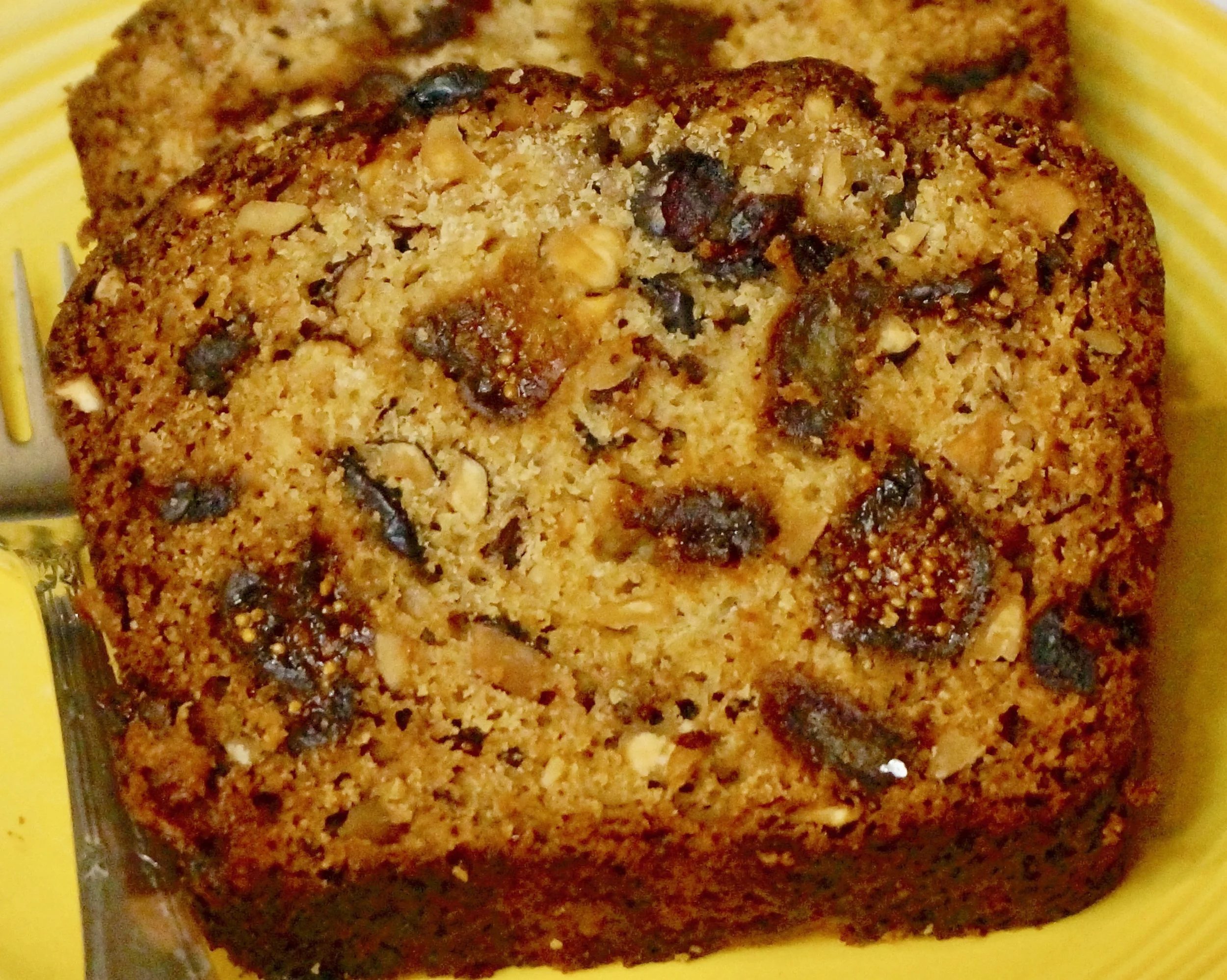
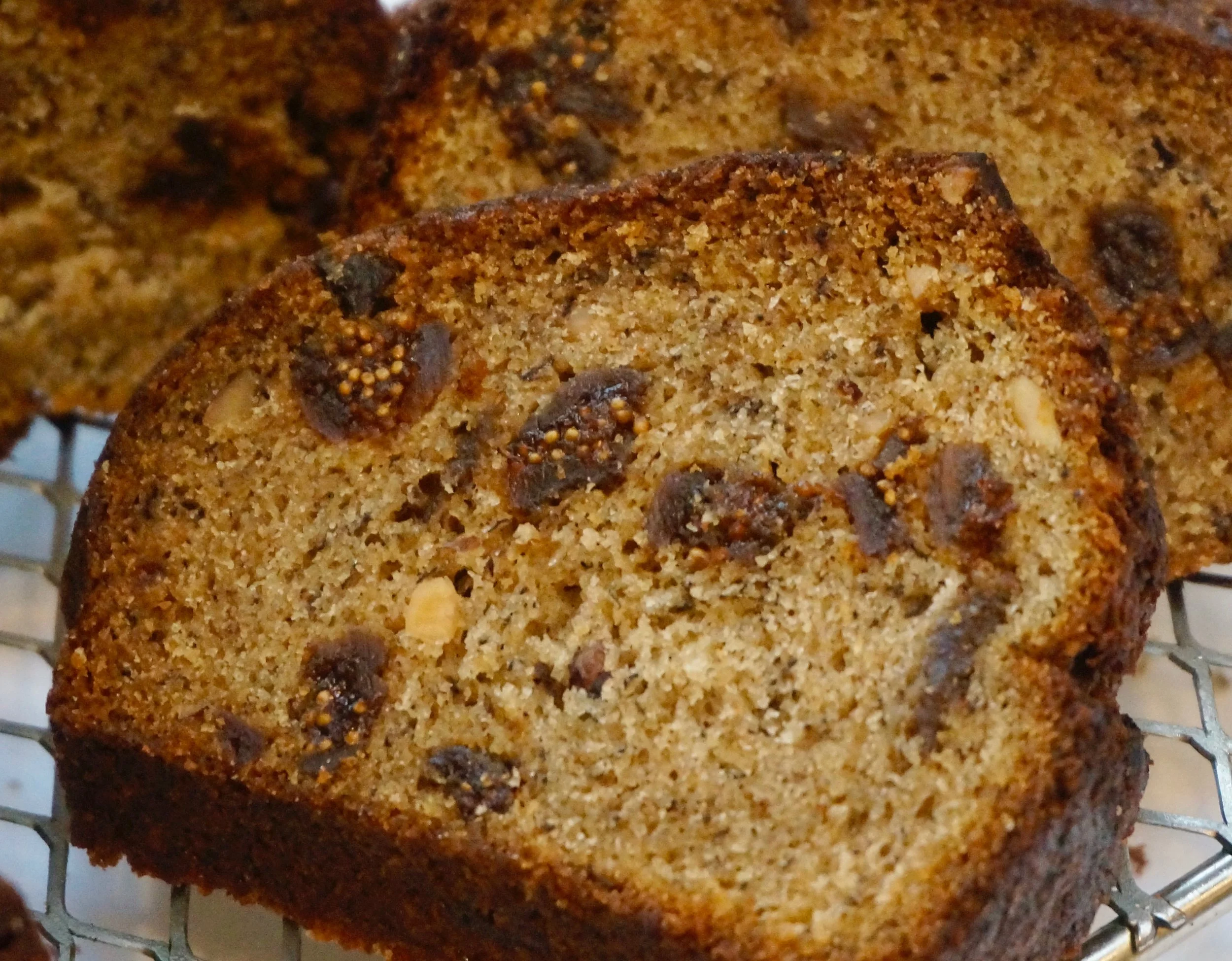
Banana Bread with Dates and Figs

_DSC2355.jpg

Every Purim I try new hamantaschen from different bakeries. I've also made my own hamantaschen using a variety of recipes.

But so far, after years and years of buying this one and that one, my favorites are the (parve) ones I get at The Bakery, in Plainview, NY. For me, they are the enduring treats of childhood, never failing to please, never changing, even in a world where innovation is honored.

And so -- I will buy my hamantaschen this year. Old fashioned flavors: prune and apricot. At The Bakery.

Which means that for Purim, instead of creating a completely new hamantaschen recipe or even trying a new pastry recipe with old fashioned filling, I am going to bake banana bread as mishloach manot gifts.

I have a zillion recipes for banana bread. Some with streusel. Some dairy-free. Some loaded with chocolate chips, some with coconut. Some all chocolate-y. Some spicy. And on and on.

This is my most recent banana bread recipe, one I came up with while revising my mother's date-nut bread recipe. 


Banana Bread with Figs, Dates and Nuts

  • 2-1/2 cups all-purpose flour
  • 1 teaspoon salt
  • 2 teaspoons cinnamon
  • 2 teaspoons baking soda
  • 1 cup vegetable shortening
  • 1-1/2 cups sugar
  • 4 large very ripe bananas, mashed
  • 4 large eggs
  • 1 cup chopped dried figs
  • 1/2 cup chopped dried dates
  • 1/2 cup chopped toasted almonds

Preheat the oven to 350 degrees. Grease and flour a 10-cup bundt pan. Mix the flour, salt, cinnamon and baking soda together in a bowl. In the bowl of an electric mixer set at medium speed, beat the shortening and sugar until well blended. Add the bananas and beat them in thoroughly. Add the eggs and beat them in thoroughly. Add the flour mixture and beat for a minute or so until the batter is well blended. Fold in the figs, dates and nuts. Pour the batter into the prepared pan and bake for about one hour or until a cake tester inserted into the center comes out clean. Remove from the oven and let cool in the pan for 15 minutes. Remove to a cake rack to cool completely.

Makes one bread, serving 16-18
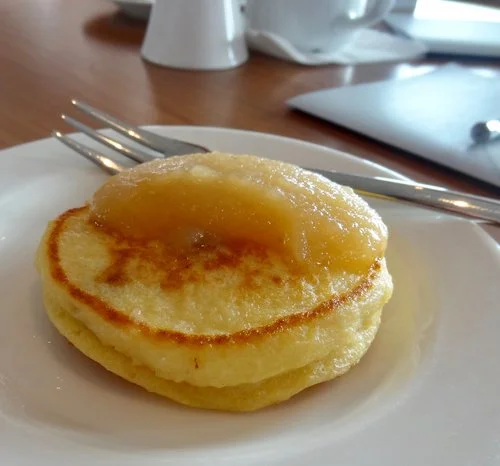
 

Buttermilk Pancake Day

One of the first newspaper food articles I ever wrote had to do with Shrove Tuesday (tomorrow, February 28th), a holiday my family doesn't celebrate, so at the time I didn't know that it is also Mardi Gras (Fat Tuesday), and in food circles -- Pancake Day!

Live and learn. It seems that in days gone by, when the Catholic Church imposed stricter rules during Lent, fatty items such as eggs, butter, milk and so on, were forbidden from Ash Wednesday, when Lent begins, until Easter. So the day before Lent everyone tried to eat up all the fats in the house.

Hence, the eating of gras (fat) on that mardi (Tuesday).

What's a delicious, filling, welcome and wondrous way to include eggs, butter, milk and stuff?

Pancakes!

I've made all sorts of pancakes: German Apple, Oatmeal, Lemon-Cottage Cheese and others. But plain old buttermilk pancakes are simple and always fluffy and full of down home pleasure.

Maple syrup goes on top, for sure. But homemade apple sauce is a bit different, less sweet and so easy to make. I like to mix apples and pears for sauce during the winter because there are so many pear varieties available. 

Happy Pancake Day. Mardi Gras. Btw, this also makes a nice dinner on a meatless Monday.

Buttermilk Pancakes with Apple-Pear Sauce

  • 3 tablespoons butter
  • 2-1/2 cups all-purpose flour
  • 2 tablespoons sugar
  • 1 teaspoon baking powder
  • 1 teaspoon baking soda
  • 1/2 teaspoon salt
  • 1 large egg
  • 3 cups buttermilk
  • butter for frying the pancakes
  • Apple-Pear Sauce

Melt the 3 tablespoons butter and set aside to cool. Mix the flour, sugar, baking powder, baking soda and salt into a bowl. In a second bowl mix the egg, buttermilk and melted, cooled butter. Add the liquid ingredients to the dry ones and mix to blend them but do not beat vigorously. Preheat a griddle or large saute pan over medium heat. Lightly butter the pan before cooking the pancakes. When the pan butter has melted and looks foamy, slowly pour about 2 tablespoons batter (for small pancakes) or more (for larger pancakes), leaving space between each pancake. Cook for about 2 minutes, or until bottom is lightly browned and bubbles form on the top. Flip the pancakes with a rigid spatula and cook for a minute or until the second side is lightly browned. Serve with Apple-Pear Sauce.

Apple-Pear Sauce

  • 4 apples
  • 3 pears
  • 1/8 teaspoon cinnamon

Peel, core and slice the apples and pears and place the pieces in a saucepan. Add the cinnamon, stir, cover the pan and cook over low heat for 25-30 minutes or until the fruit is soft. Stir occasionally during the cooking process. Puree the ingredients in a food processor with a hand blender. Serve hot, cold or at room temperature. Makes about 3-1/2 cups.

Makes 6-8 servings


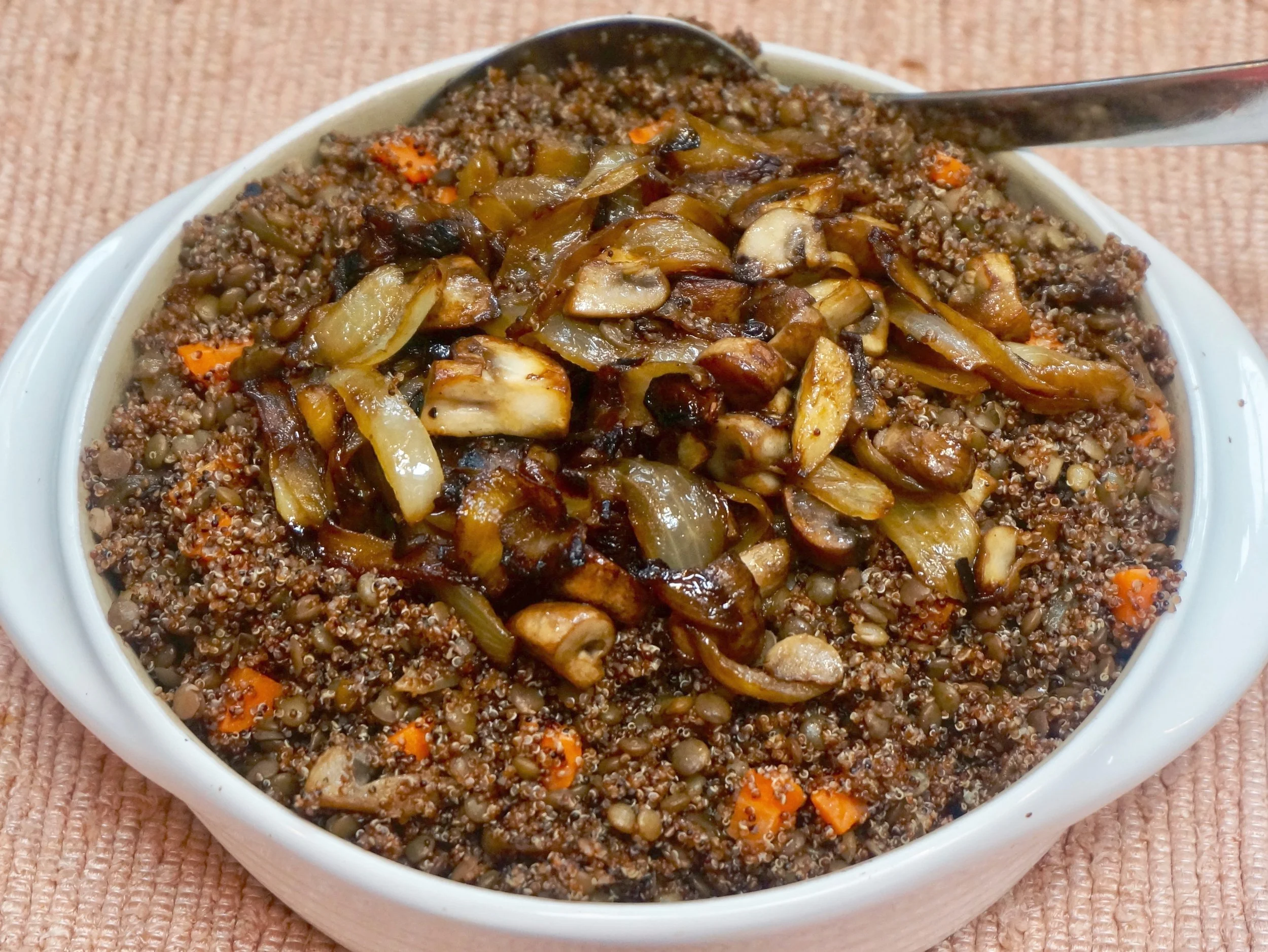
Kaniwa Mujadarah

_DSC2680.jpg

Everyone who knows me knows that Mujadarah is among my favorite things to eat. I serve it for my annual break-the-fast. I serve it anytime I have lots of people over for a celebration, like a birthday or a welcome-to-the-world party for a new grandchild.

I've made Mujadarah using brown rice. I've made it with bulgur wheat

Sometimes I add mushrooms (there's a recipe for that in my book, Hip Kosher).

Recently, the good folks at Pereg sent me a bag of Kaniwa. 

What?

Have you heard of kaniwa?

It's similar to quinoa (in fact some call it baby quinoa), but the seeds are much smaller (about the same size as poppy seeds). It is a complete protein, it's gluten-free and high in iron. That is a big big deal when you are looking for nourishing, meat-free recipes.

Unlike quinoa, kaniwa does not have a coating of saponin on the surface, which means it does not have the somewhat bitter, somewhat soapy taste that some find objectionable in quinoa. You don't have to rinse kaniwa (in fact, if you do, these teeny things will fall right through the holes in the strainer!).

I've actually cooked with kaniwa. A while ago I posted a recipe for Kaniwa Salad with Roasted Tomatoes. It's a terrific base for salads. A nice soup filler. You can sweeten it and eat it like cereal, for breakfast.

But me, with my mujadarah love? I made some kaniwa mujadarah! Look how beautiful this is! Perfect dish for a meatless Monday.


Kaniwa Mujadarah

  • 3/4 cup lentils
  • water or stock
  • 3 carrots, diced
  • 1 cup kaniwa
  • 1-3/4 cup water
  • 1/2 cup olive oil
  • 4 large yellow onions, peeled and sliced
  • 10 ounces mushrooms, cut up
  • 1/2 cup chopped fresh parsley, optional
  • 1 teaspoon ground cumin, optional
  • salt to taste

Place the lentils in a saucepan, cover with water and bring to a boil over high heat. When the water starts to boil, lower the heat, cover the pan and cook the lentils for about 25 minutes or until they are tender. Drain the lentils and set them aside. While the lentils are cooking, place the carrots in a saucepan, cover with water and bring to a boil over high heat. When the water starts to boil, lower the heat, cover the pan and cook the carrots for 5-6 minutes or until they are tender. Drain the carrots and set them aside. Place the kaniwa in a saucepan, cover with 1-3/4 cups water and bring to a boil over high heat. Lower the heat, cover the pan and cook for about 15-18 minutes until all the water has been absorbed. While the kaniwa is cooking, heat 5 tablespoons of the olive oil in a large saute pan over medium heat. Add the onions and cook, stirring occasionally, for about 10 minutes or until beginning to brown. Add the mushrooms and cook an additional 5 minutes or until the onions and mushrooms are soft and brown. Place the lentils, carrots, kaniwa and most of the onion-mushroom mixture in a bowl. Stir gently to distribute the ingredients evenly. Stir in the remaining olive oil. Add the parsley and cumin, if desired and toss the ingredients. Sprinkle with salt to taste. Top with the remaining onion-mushroom mixture.

If serving at a later time, cover the pan and reheat in a covered baking dish in a preheated 350 degree oven.

Makes 6-8 servings


Mom's Date-Nut Bread

Tu B'Shevat is one of the lesser known Jewish holidays, but also one of the more delicious ones. From my childhood I remember it as a time when my mom would buy dried figs that came in a wreath of sorts, the figs tied together with string.

I ate dozens of them.

It was also when she made her fabulous Date-Nut Bread. She served the slices like a sandwich, with cream cheese slathered between the layers. 

I ate dozens of those too.

My cousin reminded me that her mother and mine baked Date-Nut bread in a coffee can. Yes, of course! Because our mothers were married young women during WWII, when metal -- and therefore loaf pans and other assorted baking equipment -- was in short supply. So they kept the cans from ground coffee and other foods such as fruit cocktail and used those instead.

I recently made a batch of date-nut bread using my mom's recipe. I used a loaf pan and was a little disappointed. Not in the pan. In the bread. It seemed dry. Maybe I over baked it. Not sure, but I always loved this recipe, so I tried again but made a few changes.

I used less flour.

I also thought it might be a good idea to include some figs (or, frankly, any other dried fruit) with the dates and I also thought the flavor would perk up a bit with a small amount of fresh orange peel. 

My mother added Madeira or sherry, but because I had a lovely sample of Cherry Heering that I got at Kosherfest, I used that instead. She also mixed in walnuts but because of allergies, I replaced them with toasted almonds.

Of course, the bread was completely different with all these changes.

I loved it.

Especially when sliced and slathered with cream cheese.


Mom’s Date-Nut Bread New Version

  • 1-3/4 cups all-purpose flour
  • 1 cup sugar
  • 2 teaspoons baking soda
  • 1 teaspoon salt
  • 1 cup chopped dates
  • 1 cup chopped dried figs, apricots, cranberries, cherries, prunes or raisins
  • 1 cup chopped toasted almonds
  • 2 teaspoons grated fresh orange peel
  • 2 tablespoons vegetable oil
  • 2 tablespoons Orange brandy, cherry Heering, Madeira, Port or Sherry wine
  • 1 large egg
  • 1 cup boiling water
  • cream cheese, optional

Preheat the oven to 350 degrees. Grease a 8”x4-1/2”x3” loaf pan (or a one-pound coffee can). Mix the flour, sugar, baking soda and salt into a bowl. Add the fruits and nuts and toss the ingredients to coat the fruit with the flour mixture. In another bowl, combine the vegetable oil, wine and egg. Pour the boiling water into the fruit-flour mixture and mix thoroughly. Add the egg mixture and blend it in thoroughly. Spoon the batter into the prepared loaf pan. Bake for about 50 minutes or until a cake tester inserted into the center comes out clean. Let the bread cool in the pan for 10 minutes. Invert onto a cake rack to cool completely. Slice and serve plain or with cream cheese.


Makes one loaf


Chicken Soup Burgers

My daughters are not big meat eaters, so when they were young kids and still living at home,  I never made stuff like roast beef or beef stew or meatloaf. They just didn't want any of it.

They didn't even eat hamburgers.

We were basically a chicken and turkey family (including chicken and turkey burgers).

Also, I would make burgers out of all the vegetables I used for chicken soup, which I cooked more often than almost everything.

That was a kid favorite. They still talk about those burgers.

Recently I made some chicken soup because, well, it's been rainy and gloomy in my part of the world and soup is like magic to help get you in a good mood. I used the leftover vegetables for burgers, just for the two of us. Fabulous not-quite-meatless dinner. Of course you can make this a vegetarian meal with regular cooked vegetables not from soup!


CHICKEN SOUP BURGERS

  • 8 cooked carrots, cut up

  • 6 stalks cooked celery, cut up

  • 2 cooked parsnips, cut up

  • 1 large cooked onion, cut up

  • some sprigs of cooked dill

  • 1 large egg

  • 1/2 cup matzo meal

  • salt and freshly ground black pepper to taste

  • vegetable oil

Place the cooked vegetables and dill in a food processor and pulse to combine them and chop them into very fine pieces. Spoon the contents into a bowl. Add the egg, matzo meal and some salt and pepper to taste. Mix thoroughly to combine the ingredients evenly. Shape portions of the mixture into patties about 1/2-inch thick. Heat about 1/4-inch vegetable oil in a saute pan over medium-high heat. When the oil is hot enough to make a crumb sizzle, add the patties, a few at a time, leaving space between them in the pan. Do not crowd the pan. Fry the patties for about 3 minutes per side or until golden brown and crispy. Drain on paper towels. 

Makes about 12


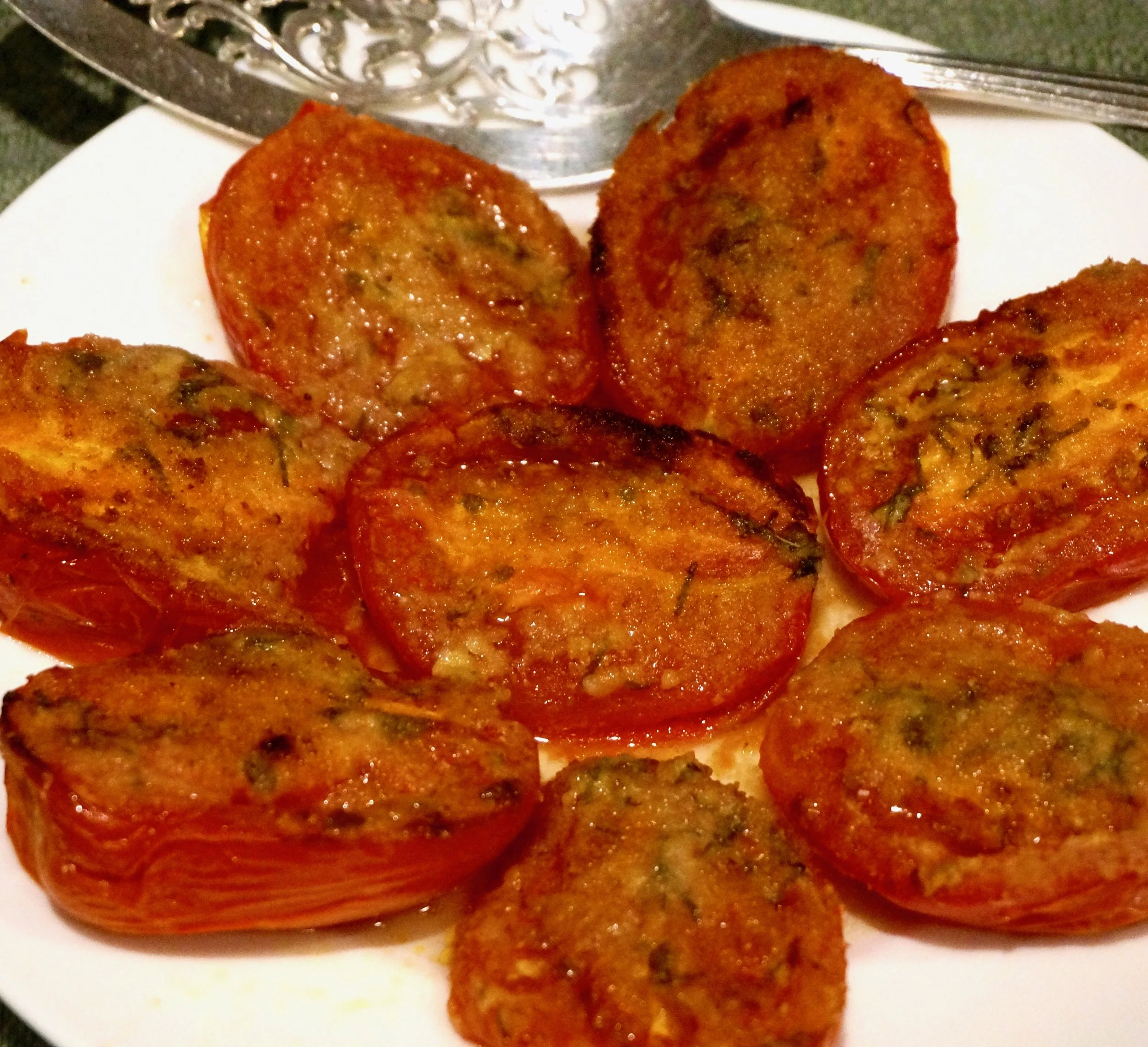
Roasted Plum Tomatoes

_DSC9730.jpg

When it's really really cold outside, (like it is where I live) I think of soup and make a pot or two

But I also dream about summer and sunshine and the garden fresh tomatoes you can only get at the end of August.

Winter tomatoes are not good. Not for salad anyway. They're typically too hard and the flesh is usually too dry.

But a good tomato taste does come out when you cook them, especially if you use Roma (plum) tomatoes. Use them for sauce for spaghetti or in ShakshukaBraise them with string beans as a side dish.

Roasted tomatoes are also flavorful, even if you use winter tomatoes. This dish couldn't be simpler. It goes with any meat protein and also as part of a meatless Monday meal. 

CRISPED ROASTED TOMATOES

  • 4 large plum tomatoes
  • 1 tablespoon olive oil
  • 1 teaspoon Dijon mustard
  • 2 teaspoons chopped fresh herbs
  • 2 tablespoons dry bread crumbs
  • cayenne pepper, optional

Preheat the oven to 450 degrees. Cut the tomatoes in half lengthwise and place them cut side up in an ovenproof pan. Mix the olive oil and Dijon mustard and brush this evenly over the tops of the tomatoes. Sprinkle with the herbs and breadcrumbs. Dust lightly with a pinch of cayenne pepper for more flavor. Roast for 20-25 minutes or until the tops are crispy.

Makes 4 servings

Latkes of a Different Kind

Hanukkah wouldn't be right without latkes. And, while classic potato latkes are my favorite and I once made 200 of them for my sister-in-law and brother's annual holiday party, I also like to cook up different varieties.

In addition to fried foods, dairy is also an iconic food for Hanukkah.

So -- dairy latke!

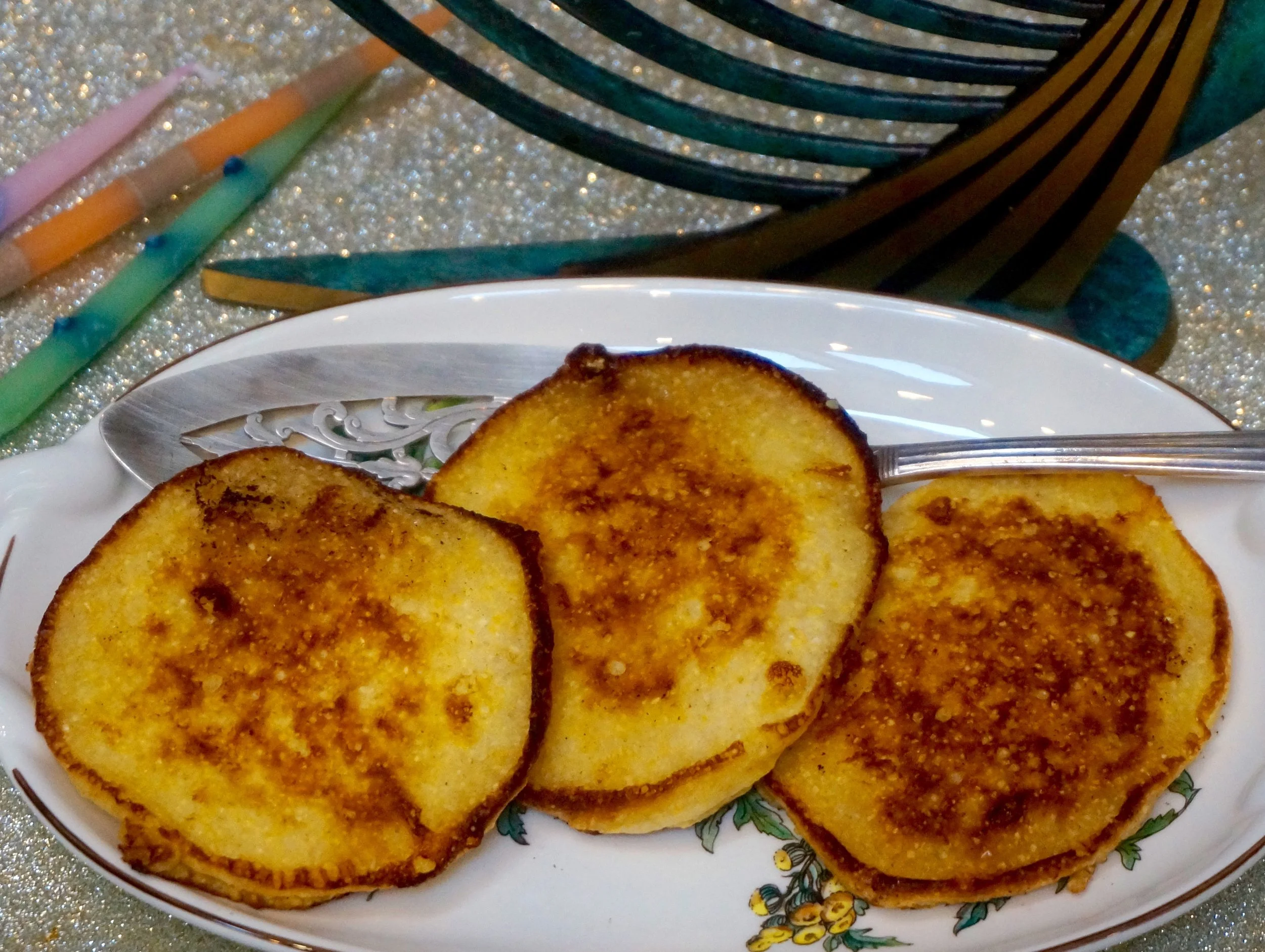
This one is made with cornmeal and cheddar cheese. Good for breakfast, lunch or as a side dish at a vegetarian meal. Perfect accompaniment to sunnyside eggs, for dipping into runny yolks.

Also, versatile. Add chives, scallions, corn kernels, chili peppers. Whatever.

Also -- make them ahead and rewarm. 


Cornmeal-Cheddar Latkes

  • 4 tablespoons butter
  • 1-1/2 cups all-purpose flour
  • 1-1/2 cups cornmeal
  • 3 tablespoons sugar
  • 2 tablespoons baking powder
  • 1 teaspoon salt
  • 2-1/3 cups milk, approximately
  • 2 large eggs
  • 5 ounces shredded cheddar cheese 
  • butter for frying
  • optional: 1 small chopped jalapeno or serrano pepper; 1 cup corn kernels; 2 tablespoon chopped chives

Melt the butter and set it aside to cool. In a bowl, mix together the flour, cornmeal, sugar, baking powder and salt. Set aside. In a separate bowl, mix the milk, eggs and cooled melted butter. Pour the milk mixture into the flour mixture, stirring gently. Fold in the cheese. If the mixture seems too thick, stir in more milk.

Heat about 1 tablespoon butter in a sauté pan over medium-low heat. When the butter has melted and looks foamy, drop 1/4 cup of the batter per pancake and cook for 2-3 minutes per side or until golden brown.

Makes about 24


Saigon Chicken Pho

Last March Ed and I travelled to Vietnam and Cambodia. We had wanted to go to both countries for years, Angkor Wat (in Cambodia), the big draw of course. But when we were young adults it wasn't possible because of the Vietnam War, which, btw, the Vietnamese call The American War.

And then way led upon way, we took other roads more or less travelled until finally this trip got on our radar and we grabbed the opportunity.

It was a revelation in many ways. Because of the politics. Because these days Vietnam is a friend and trading partner. Because Vietnam is thriving, entrepreneurial and modern whereas the only photos I had in my head were horrific ones from the 1960s (and if you have any desire to see those they are on full display in Saigon's War Remnants Museum). 

I also didn't realize how totally different Vietnam and Cambodia are. In every way: culture, ethnicity, religion, language, food, the look of the people.

I vowed to try cooking some of the food we sampled in both countries. 

So far, so good. Especially the pho, one of Vietnam's iconic dishes.

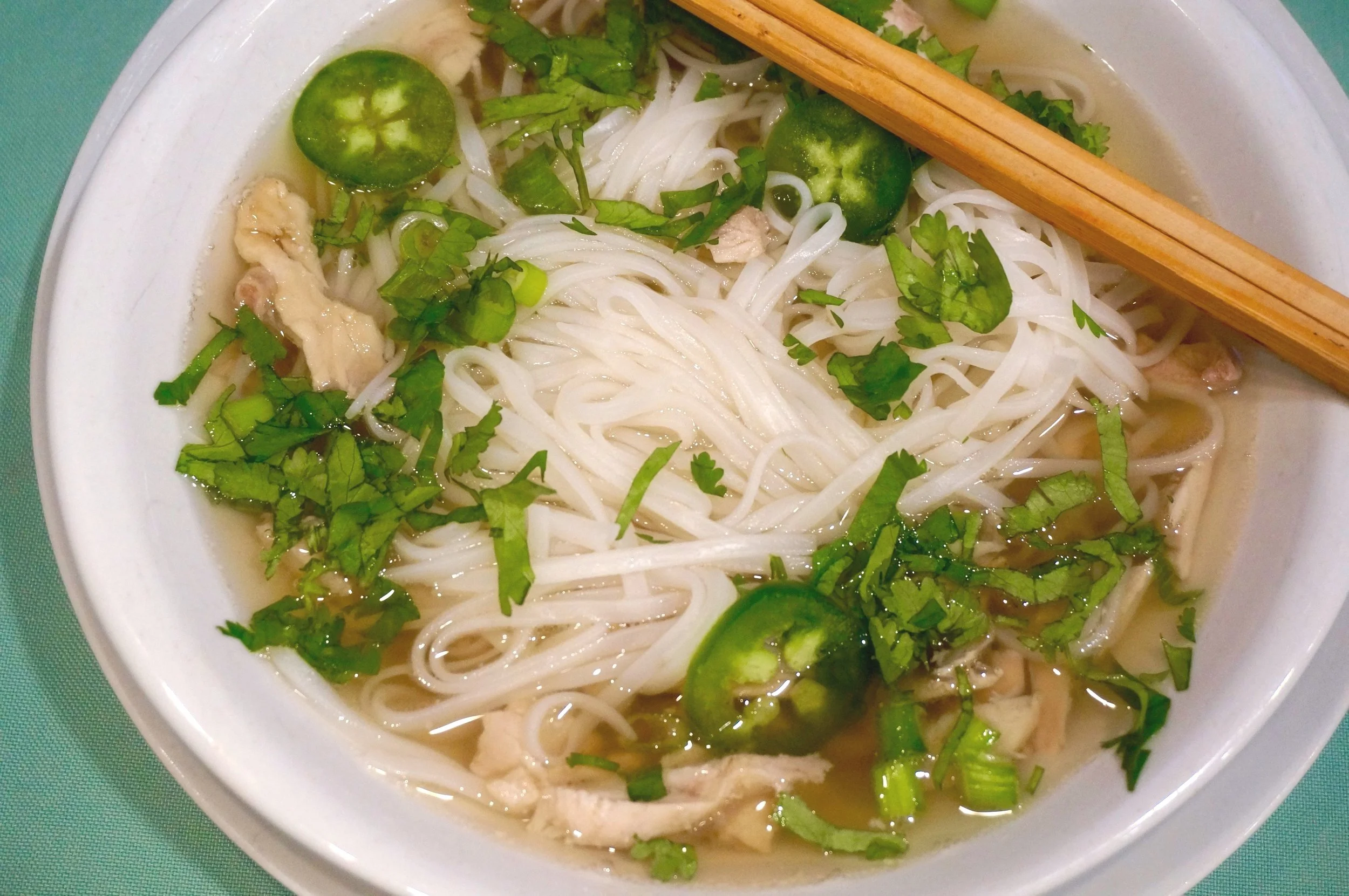
Chicken Pho -- basically chicken noodle soup -- is what your bubbe would make if she were Vietnamese. It's nourishing, flavorful, rib-sticking, comforting, warmth-giving. Perfect now that the cold weather is upon us, at least here in Connecticut. 

Really. Try this pho. I can't stop wanting some.

Fyi, the second photo is a scene from the breathtakingly beautiful Ha Long Bay in what used to be called North Vietnam. The third photo is the scene in Saigon (Ho Chi Min City) where the helicopters took off on that fateful day in 1975 when the Americans left.


SAIGON CHICKEN PHO

  • 3-1/2 to 4 pound chicken

  • 2 whole star anise

  • 6 cloves

  • 1 tablespoon coriander seeds

  • One 2 1/2-inch cinnamon stick

  • 1 teaspoon black peppercorns

  • 1 medium onion, quartered

  • 3 1-inch thick slices fresh ginger

  • 1 tablespoon dark brown sugar

  • 8 ounces dried rice noodles

  • 3-4 chopped scallions

  • 1/4 cup chopped cilantro

  • garnish to taste with thinly sliced jalapeno peppers, bean sprouts, basil leaves, mint leaves, lime wedges. Sriracha (in the United States)


Preheat the oven to 400 degrees. Place the chicken in a soup pot and cover with water. Bring the liquid to a boil over high heat. Turn the heat to low and simmer for 4-5 minutes, removing the debris that rises to the top. While the chicken in cooking, place the star anise, cloves, coriander seeds, cinnamon stick and peppercorns in a single layer in a small dish. Roast the spices for 3-4 minutes, or until fragrant. Add the roasted spices to the soup pot. Add the onion, ginger and brown sugar. Simmer the soup for about 2 hours, until the chicken is very soft. Strain the soup. Remove the chicken to a carving board and, when cool enough to handle, remove and discard the skin and bones. Cut the breast and thigh meat into julienne shreds. (Use the rest of the chicken for other purposes or add more to the soup.)

Keep the soup stock hot over low heat. Cook the rice noodles according to package directions.

To serve, place some rice noodles in serving bowls. Pour the stock over the noodles. Scatter scallions and cilantro into each serving bowl. Garnish as desired with jalapeno pepper slices, bean sprouts, basil leaves, mint leaves and lime wedges.

Note: in restaurants in the United States it is customary to serve Pho with Sriracha sauce on the side, to splash into the soup. Not the case in Vietnam, where fresh chili peppers do the job of spicing the soup.

Makes 8 servings

Winter Squash and Cranberry Muffins Perfect for Sleepovers

It's December already and I am still sorting through summer clothes and several newspaper articles from last March and April that I was going to read when I had more time.

Why am I always so far behind?

I should be posting about Hanukkah. But somehow I am more focused on New Year's weekend. Probably because I made some unbelievably delicious winter squash muffins recently.

That really isn't a non sequitur. I thought of these muffins because every year we celebrate the coming new year with my brother and sister-in-law and my cousins. The cousins sleep over for a few days. We watch a lot of movies. Watch a lot of British mystery tv (Morse, Endeavor, Foyle's War, etc.). We sit around and enjoy each other's company.

We used to drink a lot of wine but have slowed down over the years.

We used to eat much more too.

(You get older, you can't keep going quite the same way, the same amount, the same speed.)

Still, there are meals to consider.

Breakfasts are usually smoked fish, bagels and stuff like that. 

But every once in a while I like to break up the monotony and have at least one different something for breakfast.

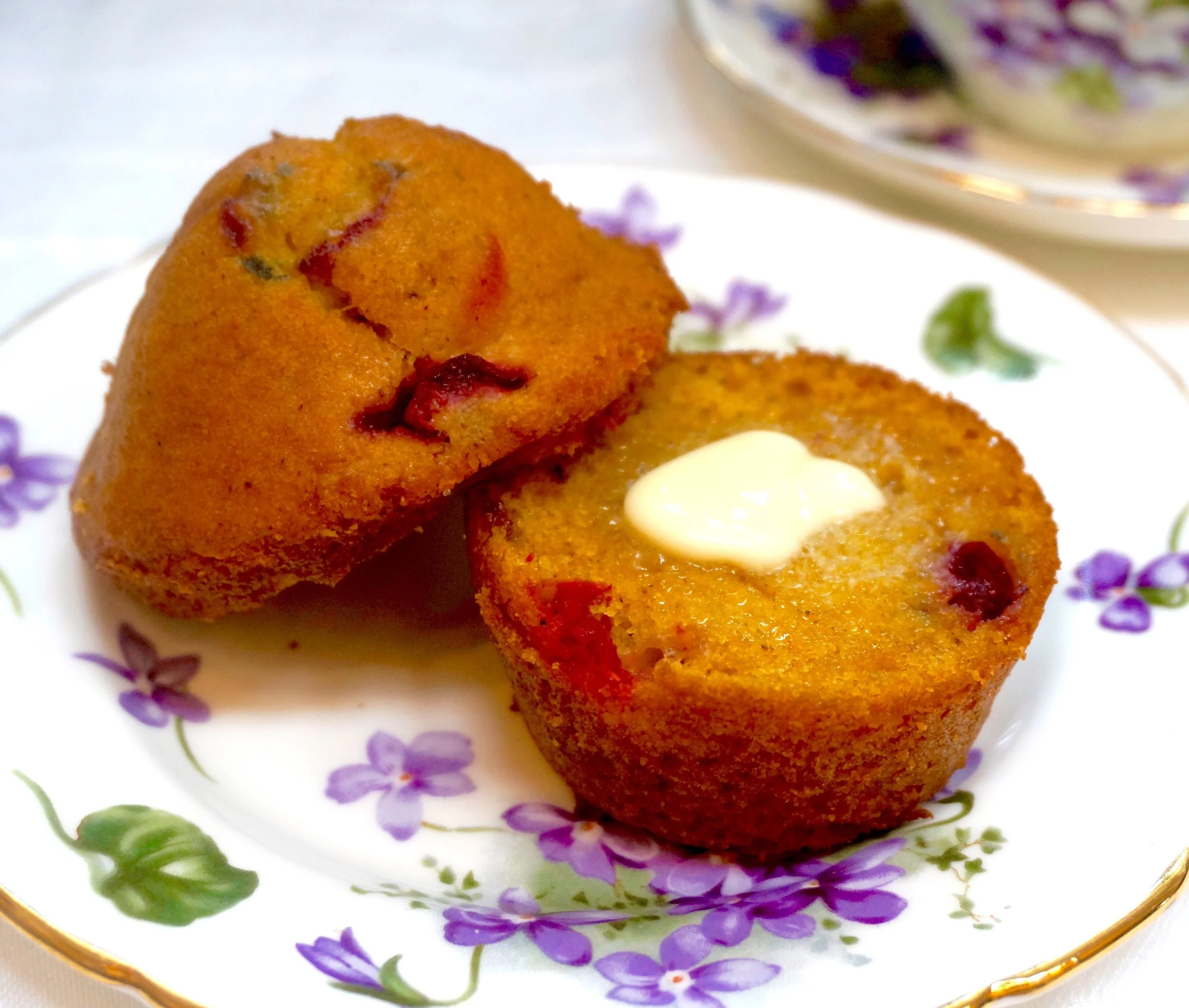
This year: those squash muffins I mentioned. I made a few batches recently and I can honestly say that they are the best muffins I ever ate. I've given some out as samples to my usual "tasters." Most of them also said they were the best muffins they ever ate. 

You'll see.

WINTER SQUASH-CRANBERRY MUFFINS

  • 1-3/4 cups all-purpose flour
  • 1 teaspoon baking soda
  • 1/2 teaspoon baking powder
  • 3/4 teaspoon salt
  • 3/4 teaspoon ground cinnamon
  • 1/2 teaspoon ground nutmeg
  • 1/4 teaspoon ground cloves
  • 1/4 teaspoon ground ginger
  • 2/3 cups sugar
  • 1/2 cup vegetable oil
  • 2 large eggs
  • 1/3 cup orange juice
  • 1 cup mashed cooked squash (or canned squash or pumpkin)
  • 3/4 cup fresh cranberries

Preheat oven to 400 degrees. Lightly grease 12 muffin tins. Combine the flour, baking soda, baking powder, salt, cinnamon, nutmeg, cloves and ginger and whisk the ingredients to distribute them evenly. Set aside. Beat the sugar and vegetable oil in the bowl of an electric mixer set at medium for a minute or so or until well combined. Add the eggs and beat them in. Add the orange juice and squash and blend them in thoroughly. Add the dry ingredients to the squash mixture and stir gently until just blended. Fold in the cranberries. Pour the mixture into the prepared tins. Bake for about 20 minutes or until a toothpick inserted into the centers comes out clean.

Makes 12 muffins


Chicken Fried Steak

_DSC1002.jpg

Several years ago my daughter Gillian and I drove from Chicago through some of the border states on our way back home to Connecticut.

We had a grand old time that included a (tasting) tour of the Jack Daniel's distillery in Lynchburg, Tennessee.

We also heard Grandpa Jones sing at the Grand Ole' Opry in Nashville.

One of the most astonishing things we witnessed were the thousands of people Christmas shopping in July in the malls in Gatlinburg (with motel accommodations priced at $39/night so you could shop till you dropped for more than one day).

Slowly we made our way through the magnificent Great Smoky Mountains. That was truly glorious.

And, last but not least, we saw -- everywhere we looked -- a lot of people eating chicken fried steak.

For breakfast!

Chicken fried steak for breakfast!

I love understanding local cuisine and sometimes even trying it. Somehow chicken fried steak smothered with gravy and accompanied by mashed potatoes and biscuits for breakfast seemed a bit much.

But that didn't stop me from trying it at home.

For dinner, of course.

Chicken fried steak, made properly (in the border states), is made with round steak. I substituted skirt steak. Anyone who has eaten skirt steak understands it can be tough, but you can pound it to make it more tender.

Or, you can use rib steak, but I think that's a waste for this particular recipe because, really, this kind of dish is about the fried, not the fabulous beef. If you do use rib steak though, be sure to slice it thin.

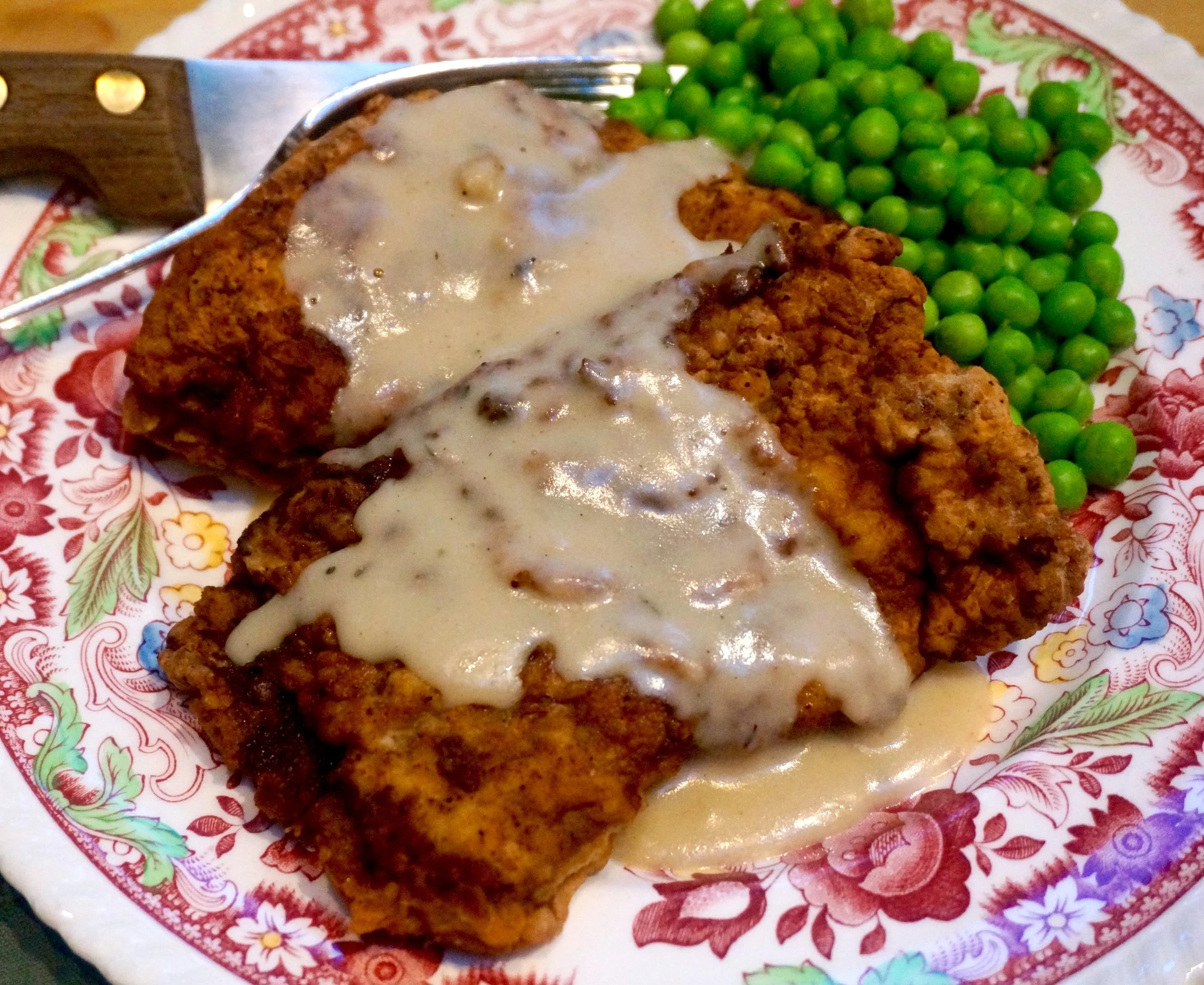
We didn't mind the chewiness of the skirt steak. Like fried veal or chicken cutlet, the outside is crispy and the inside moist and flavorful. The gravy is an indulgence.

Glad I tried it, but I wouldn't serve this for breakfast!

Chicken Fried Steak

  • 2 pounds skirt steak, approximately
  • 1-1/4 cups all-purpose flour
  • 1/2 teaspoon garlic powder
  • 1/2 teaspoon paprika
  • 1/2 teaspoon dried thyme
  • 1/4 teaspoon cayenne pepper
  • salt to taste
  • 2 large eggs plus 2 teaspoons water, beaten together
  • vegetable oil
  • use 2 tablespoons of the seasoned flour for gravy
  • 1-1/3 cup chicken stock
  • 1/3 cup soy or rice milk (or more chicken stock)

Preheat the oven to warm. Cut the meat into smaller portions and set aside. In a dish, combine the flour, garlic powder, paprika, thyme, cayenne pepper and salt and whisk the ingredients to blend them thoroughly. In a bowl, beat the egg and water together until well combined. Remove 3 tablespoons of the seasoned flour and set it aside separately. Press each portion of meat in the seasoned flour, coating the surface completely. Coat the meat portions with the egg, then coat again with more of the seasoned flour. Heat about 1/4-inch vegetable oil in a sauté pan over medium-high heat until hot enough to make a bread crumb sizzle immediately. Fry the meat portions a few at a time, leaving plenty of space in the pan, for about 3 minutes per side or until crispy. Drain on paper towels and continue with the remaining meat. As the portions are cooked, place them on a baking sheet and keep them warm in the oven. When all the meat is cooked, discard all but 3 tablespoons of fat from the pan. Add the reserved seasoned flour and whisk into the fat, cooking over low-medium heat for 1-2 minutes. Gradually add the stock and whisk until a smooth, thickened sauce has formed. Pour in the milk and whisk into the sauce. Remove the steaks to plates and serve covered with some of the gravy.

Makes 4 servings