Pumpkin Soup
Pumpkins and Campaign Posters
Every November the jack-o-lanterns and pumpkins stay outside on stoops and stairs way after Hallowe’en like so many campaign lawn signs after an election. But the campaigns are over and the posters are yesterday’s news while the pumpkins are still fresh and relevant, right up to Thanksgiving.
Somehow pumpkins start to feel out of place only after the first big snow.
Oh my. I forgot about that snow …
Probably because during the now infamous October snowfall in Connecticut — a friend of mine had no electricity for 9 days and as of this morning still does not have cable or internet service — I was in Egypt, where it was 110 degrees in Abu Simbel, near the Sudan border.
I loved coming back to pumpkins, even though I missed Hallowe’en. The autumn landscape helped put me back to the right time and place.
November. A chill in the air. Sweater weather but still sunny. Those campaign posters will be taken down by next weekend. But the pumpkins are still about. Time to think about pumpkin food. Like quickbread and vegetable side dishes and soup.
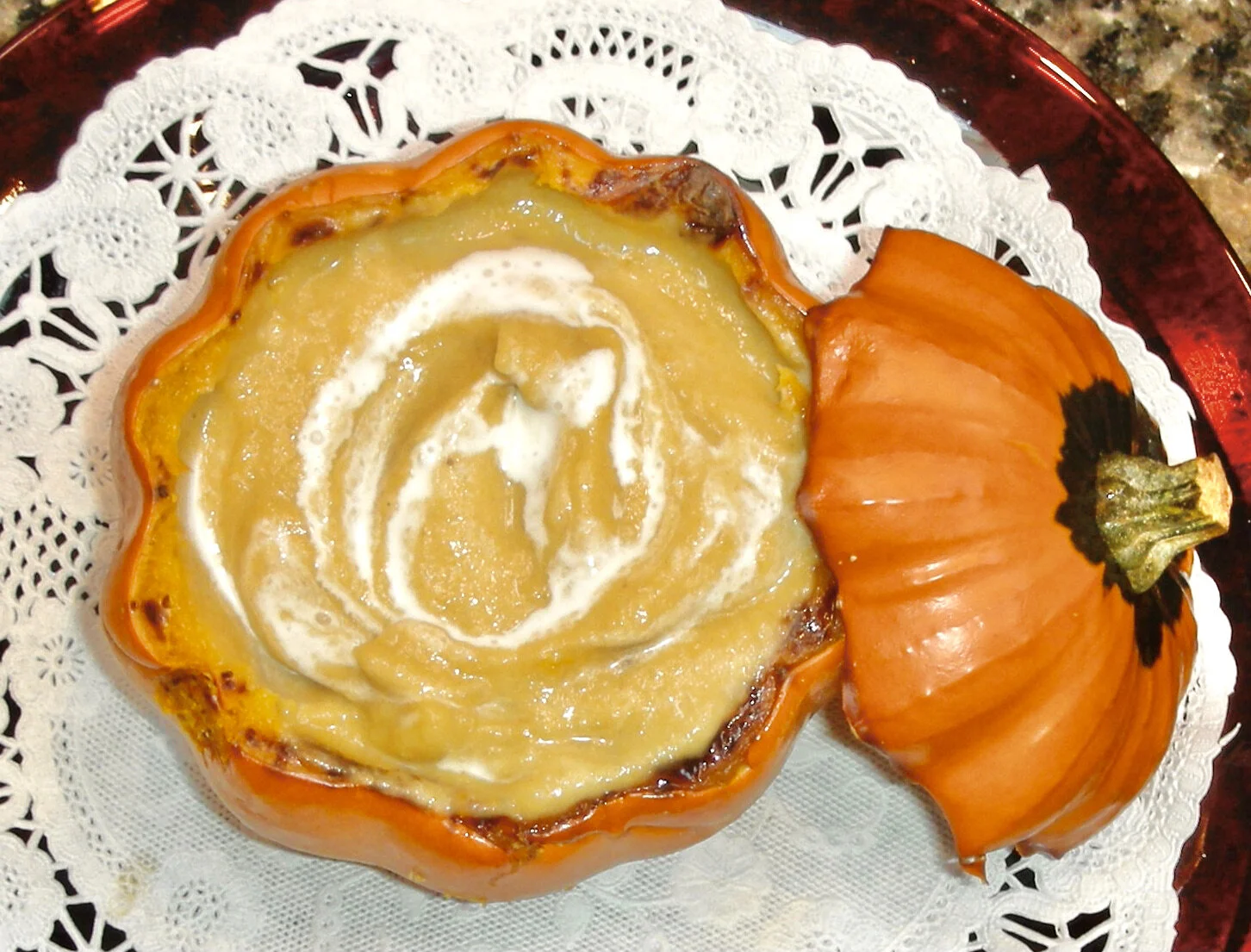
Here’s a good Pumpkin Soup recipe. This dish would be a perfect starter for a fall dinner or for Thanksgiving.
By the way, if you want to serve the soup in mini-pumpkins, here’s how to do it (and also have fresh, mashed pumpkin): preheat the oven to 325 degrees. Carve out a lid from each of the pumpkins, scoop out the seeds and spray the pumpkins and lids with baking spray. Place the pumpkins, upside down, and the lids, flesh side down, on a cookie sheet and bake for 45-60 minutes or until the outside is dark orange and the inside is tender, but not too soft. Scoop most of the flesh from the inside of the pumpkin and set aside (about 2 cups). You can also use this method using one larger pumpkin.
Pumpkin Soup
3 tablespoons butter or margarine
1 small onion, chopped
2 cups vegetable stock
2 cups pumpkin puree (canned is fine; NOT pumpkin pie mix)
3 medium tomatoes, peeled, deseeded and chopped
3 cups half and half cream, coconut milk or nut milk
1/2 teaspoon sugar
1/2 teaspoon salt
few gratings of nutmeg
whipped cream, plain yogurt or sour cream, optional
chopped scallions or chives, optional
Place the butter in a saucepan over medium heat. When the butter has melted and looks foamy, add the onion and cook for 2-3 minutes or until softened. Add the stock, pumpkin, tomatoes, half and half, sugar, salt and nutmeg. Stir to combine ingredients evenly. Bring to a boil, lower the heat and simmer the ingredients for 15 minutes. Puree the soup in a blender or with an immersion blender. If desired, serve topped with a blob of unsweetened whipped heavy cream, plain yogurt or sour cream and garnished with chopped scallions or chives.
Makes 6 servings
The Humble Hamburger: Still on my soapbox.
I just got back from Egypt where the spirit of liberty is alive and well and, hopefully, will lead to fair, democratic elections in November.
But meanwhile, the whole trip got me to thinking about politics and government and what life can be like with good government. And with bad. And what actual real people can do to make life better and more civil and government more effective.
So that got me on my soapbox about all sorts of issues that have nothing to do with politics or government, though I guess anyone who knows me knows I am like that anyway I suppose, just more so these days.
So yesterday I opined about whether healthy food is “elitist.” And the day before I posted about whether “modernist cuisine” will make “ethnic” food “redundant.”
Today I want to rant about hamburgers. Which I love, when they’re good, with juicy meat and fully of beefy flavor, but don’t like when they’re loaded with all sorts of other ingredients that, to me, actually overwhelm the flavor of the burger, so what’s the point of eating one in the first place.
On the other hand, I understand creativity in cooking. I experiment with food all the time. I take a recipe, add a little of this, substitute some of that. And so on. I’ll make Grilled Cheese and tuck in some pear and ginger marmalade. Or spice up a chicken salad with harissa and olives. So I can understand why someone would want to complement a beef burger with a condiment (like ketchup) and even include another ingredient that partners well with the meat: cheese, bacon, tomato, pickle or baked beans, for example.
But I don’t get why anyone would add more meat to a burger. Like — instead of cheeseburger maybe pastrami-burger or lobster-burger.
So I was a little astonished to read this article in Restaurant News, which says that chefs are going overload on meat-enhanced burgers these days. For example, they’re topping standard hamburgers with such items as oxtail “marmalade,” pulled pork and brisket. A restaurant in Boston (Island Creek Oyster Bar) offers a burger with cheese, bacon, pickled onions, horseradish mayo and oysters. The bubba burger at Doc Crow’s in Louisville, Ky comes topped with pulled pork, beef brisket, fried green tomato, onion rings, fried egg AND cole slaw.
Want fries with that?
Can you actually taste the hamburger when there’s all sorts of stuff on it?
Hmmm. I am confused and conflicted by my need to improvise and create versus the sometimes need to keep it simple.
I guess it depends on what foods we’re talking about. Grilled cheese and chicken salad, pasta entrees and omelets and lots of other foods, I say, let’s try all sorts of add-ons and creations. But I don’t eat hamburgers too often and when I do I like it plain old. Crispy crusted and grilled and hot.
With fries.
Here’s how I make them:
The Humble Hamburger
20-24 ounces ground chuck and brisket combination
salt and pepper to taste
garlic powder to taste (about 1/2 teaspoon)
2 teaspoons Worcestershire sauce (I use vegetarian Worcestershire sauce)
2-4 tablespoons grated onion
a few drops hot pepper sauce
ice shavings
4 buns
1/4 cup ketchup
1/4 cup mayonnaise
2 tomatoes, sliced
kosher sour pickle
Preheat an outdoor grill (with the grid 6-inches from the heat) or a grill pan or saute pan. Brush the grids (or the pan) lightly with vegetable oil. Mix the meats, salt, pepper, garlic powder, Worcestershire sauce, onion and hot pepper sauce until thoroughly combined. Shape the mixture into 4 patties no more than 1-inch thick. Stuff some ice shavings into the middle. Cook for 5-8 minutes, turning once, or until the burgers reach the degree of desired doneness. (The ice shavings help keep the innermost part rare and the outside crispy.) Grill the buns, inside part down, for about 30 seconds. Spread one side of each bun with the ketchup and mayo. Top with the burger, then some tomato and pickle slices, and finally, the other side of the bun. Makes 4
Is healthy food "elitist?" More political nonsense. Plus Bean and Pasta Soup.
Another food fight. This one not about whether or not the word “ethnic,” as in cuisine, is archaic at best, an insult at worst (which I posted about yesterday). This one pits fast food versus healthful food in political combat, the theory being that fast food is for regular folk while “elitists” prefer more healthy eats. I read about it in this article.
The argument has been going on for a while. Remember when President Obama was criticized for eating arugula? As if there was something wrong with eating arugula and that he could only be “regular” if he ate a fast-food burger and fries?
And how about the criticism of Michelle Obama, whose childhood obesity task force asks restaurants to “consider” healthy choices and portion size. Mark Levin, a right-wing commentator calls the First Lady a food Nazi for her efforts. Here’s what he said:
"How the hell did we become a nation of people where we need the first lady of the United States to assume responsibility for telling us how much our children can eat and how much restaurants’ food portions should be?"
Well no one is actually assuming responsibility, and no one is telling anyone how much our children can eat, so it seems that even making the suggestion that we consider healthy choices for (at the very least, our children) is somehow elitist and tyrannical. (Anyway that’s what the jerks and cranks think.)
The latest round came when Anthony Bourdain, no stranger to controversy, criticized Paula Deen, saying that she might think twice about telling her audience that the style of food she cooks is okay. And she countered that not everyone can afford an expensive prime rib of beef and that she cooks “for regular families who worry about feeding their kids and paying their bills.” (In case you aren’t familiar with her recipes, let’s just mention the famous doughnut burger: 1/2 pound beef burger with fried eggs and bacon on a glazed doughnut.)
Notice, she didn’t say her food was healthy. Just that it was somehow more people-friendly and affordable.
So what it boils down to is that some people will call you an elitist if you care enough about the health of your families and the nation to point out that a steady diet of supersize portions of deep-fried chicken, burgers, french fries, doughnuts and soda might not be such a good thing.
As a matter of fact, I love fried chicken, burgers, fries and doughnuts. And a big thick steak. My Mom’s fried chicken recipes was a wonder and when people ask me what I would choose if I had to pick my “last meal,” I include that fried chicken. With fried onion rings and french fries. And apple pie and peanut butter cookies and a huge bowl of BUTTERED popcorn.
But knowing that these foods can be unhealthy if you eat too much of them on a regular basis doesn’t make me an elitist. And those who cook and eat that kind of food all the time aren’t more “regular” or better than I am.
Frankly, I think the opposite. As Bourdain says,
”This notion that there’s red state food and blue state food, or rich food and poor food is offensive and elitist in ways I could never be.”
Some of the best foods — and healthiest — and cheapest — are the ones concocted by the poor to nourish their families. So the notion that eating unhealthy high-fat, sugar-laden food is somehow cheaper and folksier is just nonsense.
Take this Bean and Pasta Soup. It’s a world-class, “regular folks” inexpensive dish. It’s full of vegetables and beans. It doesn’t take long to cook either and you can double up on the recipe and serve it again a few days later. Have it with a hunk of fresh bread. Add some leftover chopped meat or chicken if you wish. You’ll find it’s good to eat, tasty, healthy and cheaper than a burger with fries and soda.
And by the way, the elitists who think I (and people like me) am an elitist for thinking about whether food is healthy may scoff at the notion of Bean and Pasta Soup. So just tell them it’s really Pasta Fagiole, which gives it more of an authentic ethnic ring and may therefore make it more acceptable.
Bean and Pasta Soup
2 tablespoons olive oil
1 medium onion, chopped
1 large clove garlic, chopped
3 medium carrots, sliced 1/2-inch thick
2 stalks celery, sliced 1/2-inch thick
28-ounce can tomatoes, undrained
4 cups vegetable stock
3 tablespoons chopped fresh basil
3 tablespoons chopped fresh parsley
salt and freshly ground black pepper to taste
1/2 cup small tubular pasta (elbows, ditalini, etc.)
2 15-ounce cans kidney beans, including liquid
1 cup frozen peas
grated Parmesan cheese
Heat the olive oil in a soup pot over medium heat. Add the onion, carrots and celery and cook, stirring occasionally, for 2-3 minutes to soften the vegetables. Add the tomatoes (break them up somewhat with the back of a wooden spoon), stock, basil, parsley and some salt and pepper. Bring to a boil, lower the heat and simmer, partially covered, for 20 minutes. Add the pasta and cook for 3-4 minutes. Add the beans and cook for 5-6 minutes. Add the peas and cook for 2-3 minutes. Serve the soup sprinkled with Parmesan cheese. Makes 6 servings
Ethnic food? Is there such a thing?
Oh for goodness’ sake! Don’t we fight about enough things? Now do we have to argue about whether “ethnic” food is a real “concept” or a pejorative term?
This article in the Wall Street Journal got me all agitated. The writer says there’s no definition of “ethnic food” in the Oxford dictionary and that the term means food eaten by people poorer than we are. And apparently there was a debate on this topic at the London Restaurant Festival this year. Someone said the French coined the term to describe food that isn’t French or Italian cuisine in the Michelin guide. And another person said that the term “favors segregation over inspiration.”
But someone else said that ethnic food describes foods that exist in one place that no one else eats.
And so on, blah blah blah.
The writer then concludes that because contemporary chefs are inspired by global influences, ethnic cuisine will soon be “redundant.”
In my opinion, that would be awful.
I have been a food writer for decades. I am fully aware of “modernist cuisine,” which has no ties to any particular culture. I love it if it’s done well and look forward to creative dining and lovely, delicious foods made with intriguing, multi-national ingredients and concepts. (Though I must say, there are far too many restaurants that make too many precious looking dishes with too many ingredients and think they are modernist but it’s really just a hodgepodge).
On the other hand, I also love foods that are particular to a region or culture. I want Egyptian food when I’m in Egypt, German specialties in Germany, Pennsyvania Dutch food in Pennsylvania. I am not insulted when people refer to my grandmother’s recipes as “ethnic” Jewish cooking. Frankly, I would hate it if “modernist” blintzes or “California-style” stuffed cabbage or “artisanal” challah, whatever that could mean, replaced my old favorites.
I remember taking a trip many years ago with my husband and children to Quebec. I’d been there years before and enjoyed “Cuisine Quebecoise.” Good, “ethnic” cuisine. I looked forward to it again (OH for some of that Pain du Sucre: homestyle white bread with maple sugar and cream!! So simple. So wonderful!). Unfortunately, it was not to be. All the restaurants that were recommended had “modernist” Canadian. Huge disappointment. When you have a hunger for traditional Pain du Sucre, multigrain bread with cocoa-encrusted maple sugar with rambutan-scented mascarpone foam just doesn’t cut it.
I like “ethnic” food. And I actually don’t care if people want to create riffs on the old favorites. In fact, it’s what I do.
But I still would like to feast on those old favorites too. Russian Borscht. Cantonese Egg Rolls. Polish Potato Pierogi, Israeli Falafel, Irish Colcannon, Jewish Mandelbrot.
Please tell me they will not be “redundant.”
Mandelbrot
1/2 cup butter or margarine
1 cup sugar
3 large eggs
2-1/2 to 3 cups all-purpose flour
2-1/2 teaspoons baking powder
1 tablespoon brandy or apple juice
1 teaspoon almond extract
1/4 teaspoon salt
1/2 cup chopped nuts
1/3 cup cut up candied cherries
1/3 cup chocolate chips
1/3 cup raisins
Preheat the oven to 350 degrees. Lightly grease a cookie sheet. Cream the butter and sugar together in the bowl of a mixer set at medium speed for about 2 minutes or until creamy and well blended. Add the eggs one at a time, beating after each addition. Add 2-1/2 cups of the flour, baking powder, brandy, almond extract and salt and beat at medium speed until the ingredients are thoroughly blended. Blend in the remaining flour if the pastry is very sticky. Fold in the nuts, cherries, chocolate chips and raisins. On a lightly floured surface, divide the dough into thirds and shape each piece into an oval loaf about 1-1/2 to 2 inches thick. Place the loaves on the cookie sheet. Bake for 25-30 minutes or until the loaves are golden brown. Remove from the oven and let cool. Serve sliced, as is, or toast the slices for extra crispness. Makes 3 loaves.
Farmily Values do not include child support
Deadbeat Rep. Joe Walsh, Who Owes $100k In Child Support, Receives ‘Pro-Family’ Award From Family Research Council
from Think Progress
Astonishing what this group thinks is “pro-family.” This Congressman won’t pay child support, show up for child-support hearings and he denied heath insurance coverage for his family. He gets an award?
Am I living in an alternate universe or what?
Egyptian Hummus with Tahini
What’s the most popular hors d’oeuvre?
I think it has to be hummus. I don’t have any scientific proof but I once counted the kinds of hummus sold at one of my local supermarkets and stopped when I reached 38.
Thirty-eight kinds of hummus? That’s almost as many varieties as potato chips!
Of course there aren’t actually 38 different flavors. There are several brands and some of them are the same flavor, brand to brand — like garlic flavored or spicy, olive, tahini.
But there are also some that I will call post-modern versions because I can’t think of another word for it. Like Sabra’s chipotle or Buffalo style hummus or Tribe’s hummus topped with Cilantro Chimichurri. Wow, that’s what I call fusion cuisine!
Sorry, but when it comes to certain foods, I am a purist. Like with hummus.
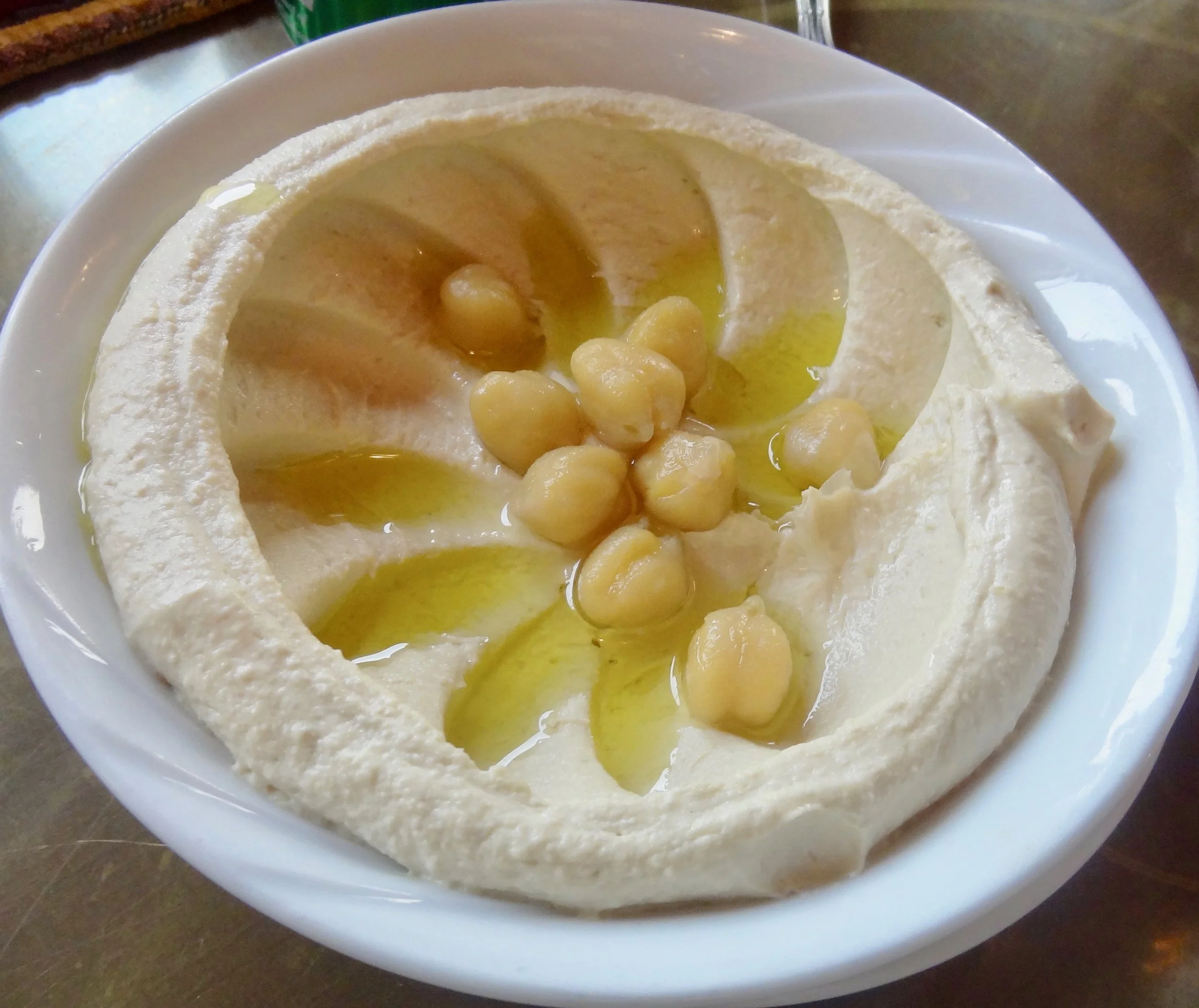
In Egypt, hummus is still blessedly kind of pure and simple, so I’ve been eating it every day with breakfast and dinner. It’s basic stuff: pureed chickpeas mixed with spices, olive oil and lots of tahini. Mix it all up in a food processor, garnish with a drizzle of olive oil and a few cooked chickpeas and it’s yummy enough. You don’t need to make it more complex or add any sauce or topping. That way you can actually taste the hummus.
Try this version — it’s easy to make, cheaper than store-bought and you won’t have to make a decision about which of the 38 (or more) flavors to buy.
Egyptian Hummus with Tahini
- 1 pound can chickpeas
- 1/3 cup tahini
- 3 tablespoons olive oil
- 2 tablespoons lime juice
- 1 clove garlic
- 1/2 teaspoon salt or to taste
- pita bread
Drain the chickpeas but reserve the liquid. Set aside a tablespoon of chickpeas. Place the remaining chickpeas in a food processor with the tahini, 2 tablespoons olive oil, lime juice, garlic, salt and 1/4 cup of the reserved bean liquid. Process until the ingredients form a smooth puree (turn the machine off and scrape the sides of the work bowl once or twice). If you prefer a thinner hummus, add some more of the bean liquid. Spoon the hummus into a serving bowl. Garnish with the remaining tablespoon olive oil and the reserved chick peas.
Makes about 1-1/2 cups
In Tahrir Square, Cairo

Tahrir Square when it’s peaceful. The usual souvenirs and tee shirts. But now so many tee shirts celebrate the January 25th revolution, emblazoned with the date or pictures of broken chains. Feels good.
Egyptian Feta Cheese Dip
When in Egypt, eat as the Egyptians do.
So I have, as I’ve been here for just under two weeks. Breakfast, lunch and dinner.
Some of the traditional breakfast food is actually not so different than what I eat at home, which usually is plain yogurt with fresh fruit or dried apricots. There’s lots of yogurt here for breakfast, all plain rather than being mixed with so much stuff that you can’t taste the yogurt.
But for breakfast here there’s also hummus, baba ghanoosh, tahini, olive salads and falafel, so I’ve been having a feast. I love all that food, but normally it’s for snack or hors d’oeuvre, not breakfast. This will change my company brunch menu for sure. All of these dishes are ones I can make ahead so there’s no fussing when people are over.
Think New Year’s weekend.
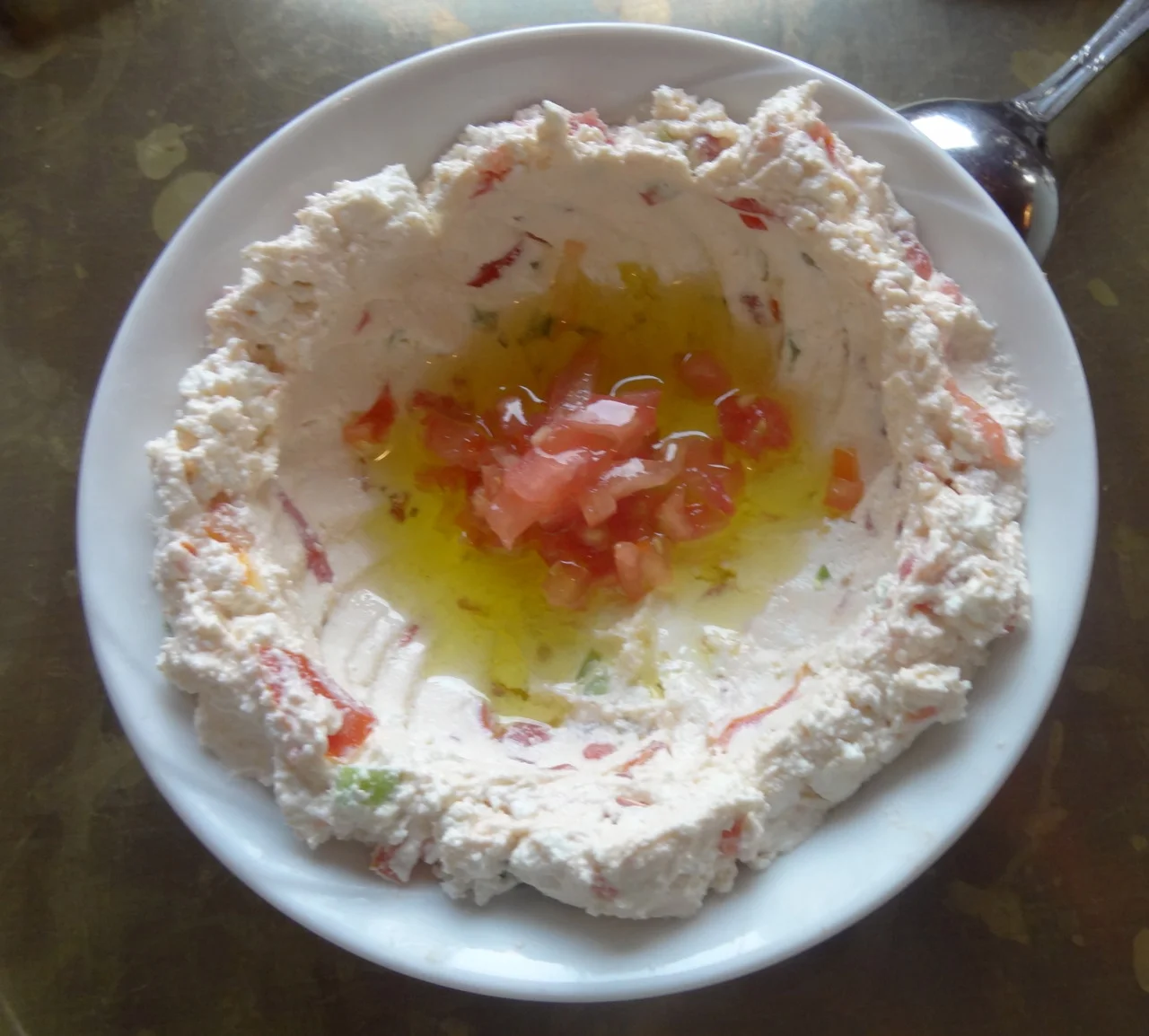
One of the more interesting breakfast dishes is the variety of feta cheese mixtures. I love feta cheese. But it’s the kind of cheese I crumble into a salad or spinach pie. In Egypt they mash it up and mix it it with lemon juice and olive oil to make it creamy, add some chopped tomatoes, scallions and sometimes parsley or mint and it becomes a spread for pita bread.
Terrific breakfast food. Great change from toast and jam.
The photo shows the way it’s served: with a drizzle of olive oil and chopped tomatoes. Try it. The recipe is something like this — use amounts of lemon juice and olive oil that suit your fancy and make the feta as creamy as you like.
Mash 6-8 ounces of feta cheese with about 2 tablespoons olive oil and about 2 tablespoons lemon juice. Beat until creamy. Add plain yogurt if desired for a creamier consistency. Add 3 chopped scallions, 8-10 chopped cherry tomatoes and 2 tablespoons chopped parsley or one tablespoon chopped fresh mint if desired. Mix thoroughly. Serve drizzled with olive oil and chopped tomatoes. Serve with pita bread. Makes 6 servings