Best Picture Ever; Yellow Cake

Cooking with kids is a world of opportunities. Yes, yes, yes, we’ve all read about how it helps build creativity and teaches them the value of experimentation. How it helps teach basic math and measurement skills and maybe even encourages them…

Cooking with kids is a world of opportunities. Yes, yes, yes, we’ve all read about how it helps build creativity and teaches them the value of experimentation. How it helps teach basic math and measurement skills and maybe even encourages them to taste something new.

But it’s also a thrilling lesson in human dynamics for grownups.

Consider this photo of Lila and Nina, my two grand daughters, making cake batter with me. Do I need to tell anyone what’s going on here?

Who’s older? Who’s neater? Do they like what they’re tasting? Have they listened to their parents’ lesson about not eating from the same fork (spoon, spatula) as someone else?

It’s like when you read a book to a kid and not just read the words but also talk about the expressions on the characters’ faces.

As they say, a picture tells a thousand words.

They liked the cake. Yellow cake. Here’s the recipe.

Yellow Cake

3 cups sifted all-purpose flour (measure after sifting)

1 tablespoon baking powder

3/4 teaspoon salt

1-1/2 cups unsalted butter

1-1/2 cups sugar

4 large eggs

1 cup whole milk

2 teaspoons vanilla extract

Preheat the oven to 350 degrees. Butter and flour 2 9-inch cake pans. Combine the flour, baking powder and salt in a bowl and set aside. In the bowl of an electric mixer set at medium speed, beat the butter and sugar together for 3-4 minutes or until smooth and creamy. Add the eggs one at a time, and beat until thoroughly blended in. Combine the milk and vanilla extract. Using about 1/3 of the ingredients at a time, alternately add the flour mixture and milk mixture to the butter mixture, blending each addition in before adding the next batch. Spoon equal amounts of batter into the prepared pans. Bake for about 30 minutes or until a cake tester inserted into the center comes out clean. Let cool in the pans for 10 minutes, then invert onto a cake rack to cool completely. Frost with your favorite frosting. Makes one cake, 2 layers.
Saint Cupcake Red Velvet Cake

If I could go anywhere today it would be to Saint Cupcake, which makes gorgeous looking cupcakes in all sorts of flavors that you just don’t see everywhere. Like the “Fat Elvis,” which is a banana-chocolate-chip poundcake bottom iced with salty-sweet peanut butter fudge and if that isn’t enough for you, they also garnish with a banana chip.

Or you can buy a Turtle cupcake with fudge and caramel and pecans on top of chocolate cake.

Of course there’s vanilla and chocolate and so on.

There’s stuff for vegans too: German chocolate cake, carrot cakes and others.

Unfortunately, the store is in Portland, Oregon, which is exactly 2992.51 miles from my house.

But I knew the owner, Jami Curl, would be the right person to contact when I needed a recipe for Red Velvet Cake, which she says is the bakery’s most popular cupcake for Valentine’s Day.

I “met” Jami on the internet, on Tumblr, and we became fast friends even though we are a continent apart and I am old enough to be her mother. Sometimes you just connect with people. You know you like them — to paraphrase a famous movie line, you know like you know a good melon. You like them based on what they say in their blogs. Besides baking all those delicious looking cupcakes, she seems like a down-to-earth person who enjoys her life and her work and reads a lot of interesting things that she posts about frequently.

Sure enough, she was generous enough to send me her recipe for Red Velvet Cake, which I am posting below.

If you’re lucky enough to live near Saint Cupcake, you can stop by to choose your favorite cupcake, icing and sprinkles (they ship stuff too).  The bakery is expanding soon, so you Oregonians will be able to buy fresh baked goodies other than cupcakes. Take a look at the website to see the cupcake offerings at the moment: saintcupcake.com

But if you’re stuck on the other side of the earth and want to make some yummy Red Velvet Cupcakes (or one cake) for Valentine’s Day or any other time, here’s Jami’s recipe. She frosts Red Velvet either with a classic 7-minute frosting or cream cheese frosting:

Saint Cupcake Red Velvet Cake

2-1/2 cups cake flour, sifted

1 teaspoon kosher salt

2 Tablespoons cocoa powder (natural or Dutch process)

1 teaspoon baking powder

1 cup buttermilk

2 tablespoons red food coloring

1 teaspoon vanilla extract

1/2 cup unsalted butter

1-1/2 cups granulated sugar

2 eggs

1 teaspoon apple cider vinegar

1 teaspoon baking soda

Preheat the oven to 375 degrees. Line 2 standard size muffin pans with baking cup liners

 In a bowl, whisk together the cake flour, salt, cocoa and baking powder. In a pitcher, combine the buttermilk, food coloring and vanilla. In a stand mixer set to medium speed, beat the butter and sugar together until light and fluffy, about 5 minutes. Add the eggs one at a time, beating until fully incorporated — scraping down the sides and bottom of bowl after each addition. Add the flour mixture in portions — alternating with the buttermilk mixture — until just blended and smooth. In a cup combine the vinegar and the baking soda — allow to fizz — then fold into the batter by hand. Divide the batter among the muffin cups and place in the oven immediately. Bake for 15 minutes then check the cupcakes for doneness with a toothpick. If you have a few crumbs clinging to the toothpick, the cupcakes are done. If the toothpick is coated with batter, then the cupcakes need a few more minutes. Take care not to overbake, they will dry out very quickly. Let the cupcakes cool in the pan for 5 minutes, then place them on  cooling rack to cool completely before icing.

Chocolate-Orange Fondue

Love and pairing off doesn’t just apply to humans. There are some really good food marriages too, culinary matches made in heaven.

Who hasn’t heard of peanut butter and jelly, spaghetti and tomato sauce, ham and eggs?

As with people, sometimes the pair works well even though one of the partners is more dominant. Think cinnamon and sugar, or hot chocolate, which wouldn’t taste good at all without the gentle grace of a little vanilla. Or a robust English Stilton, tempered by a sweet, more docile pear.

But sometimes it’s better if the partners are more or less equal as they are with sausage and peppers or tomatoes and basil.

Opposites attract, as they do sometimes with people: strawberries (plump and sweet) and rhubarb (skinny and sour) or hot apple pie with cold ice cream a la mode.

But sometimes couples are more compatible if they are more alike: fish and chips (both crunchy) or prune and apricot pie, (both bold and intense).

And of course, some couples endure because they are just plain good for each other and with each other: beans and rice, lentils and bulgur, peanut butter and whole wheat bread.

One of my favorite food pairings is chocolate and orange. This quick and easy fondue recipe is so quick and easy you can make it today even if you haven’t planned ahead for Valentine’s Day.

Chocolate-Orange Fondue

10 ounces orange flavored bittersweet chocolate, chopped

1/2 cup whipping cream

2 tablespoons orange flavored brandy or liqueur

1/2 teaspoon orange extract

strawberries, pineapple chunks, banana pieces

doughnuts, cake, cookies, macaroons, etc.

Melt the chocolate and cream together in the top part of a double boiler set over barely simmering water. Stir until the mixture is smooth and uniform. Remove the top part of the pan from the heat. Stir in the brandy and extract. Spoon the mixture into a fireproof container set over a candle. (Or use a fondue pot). Use cut up fruit, doughnuts, cake etc. to dip into the chocolate. Makes 4-6 servings

Give me an F!

fridayreads:

Give me an R!

Give me an….oh, what the heck. Just tell us what you’re reading this week.

Reblog this post to join thousands of FridayReads participants worldwide and be entered to win bookish prizes.

#fridayreads I’m reading Nemesis by Philip Roth, a novel that takes place during a polio epidemic in 1944, with a world war raging at the same time. Poignant and wonderful. I remember summers in the 1950s, when I was a little girl, before the polio vaccine was widespread and available everywhere. Every time a kid got a headache our mothers would panic. I can still feel the fear. Bravo science, Salk and Sabin for saving so many millions of lives.

Toasted Cheese with Cream Cheese and Orange Marmalade

It finally dawned on me why my mother might have made toasted cheese sandwiches, not grilled cheese. I’m guessing it was because of rationing during World War II. There wasn’t a whole lot of butter to lavish on a sandwich, so she leaned to prepare the sandwich the way I described yesterday — slices of American cheese on top of white bread, toasted in the broiler.

To confirm my suspicions, I got out my handy 1942 antique version of The Good Housekeeping Cooking (complete with its “Wartime Supplement”) and sure enough, there are, on pages 524 and 525, recipes for “Toasted Sandwiches” and even “Toasted Cheese Sandwiches - New Style,” by which they mean a kind of Welsh Rabbit.

There are several variations on the standard Toasted Cheese, including a panfried version and also one for the broiler. Here are two. They’re from long ago but still sound good:

Toasted Cheese with Cream Cheese and Orange Marmalade

6 slices bread

cream cheese

1 tablespoon orange marmalade

Preheat the oven to 500 degrees. Spread the bread with the cream cheese, then the marmalade. Place on a rack and bake for 5 minutes “or until they have crusty toasty look on the underside.” Makes 6

Or this one (you can substitute soy bacon or tomato slices):

Toasted Cheese

bread slices (meaning white bread)

butter

American cheese

bacon (or use tomato slices)

Spread some butter on the bread slices. Cover with slices of American cheese. Lay 2 half slices of bacon top. Broil until cheese is melted and bacon is crisp, turning the bacon once. 

Crisped Manchego Cheese Panini with Fig Jam

I didn’t taste a real, authentic grilled cheese sandwich until I was grown up. It’s hard to believe when I think about it, but I was fully in college when a friend asked me over and said he’d make a grilled cheese sandwich for me.

I was shocked when he slathered a piece of bread with what seemed like a whole stick of soft butter, put another huge lump of butter in a frying pan and then layered some yellow American cheese between the buttered bread and a plain slice. He fried the sandwich in the pan, covered, plain side down first, until both sides were toasty and the cheese was melted and oozing out of the sides.

Well, at least he got the cheese right.

My mother had always made grilled cheese in a toaster oven. And, in the days before toaster ovens, in the broiler. She put several slices of American cheese on one slice of white bread — NO BUTTER —and toasted it (or broiled it) open-face until the cheese was hot and melty. Sometimes giant air bubbles grew on the top of the cheese and if she waited a moment or so too long, they would burn and blacken and then break so that there were crumbles of tiny ashen cheese where the bubble used to be. When she went fancy on us she’d put a slice of tomato on top of the cheese before she cooked the sandwich.

Despite the deliciousness of my friend’s recipe, I reverted to the familiar when I made grilled cheese for my kids. White bread, open-face and toasted. It took less time, less work and of course, no butter, which made it healthier and less caloric, although you really can’t brag about healthy when you are cooking with white bread and American cheese. Fact is, this is the way we liked it.

So, this is the way I make it for my grandkids. Except now I use multi-grain bread. Until recently, when my grand daughter Nina, age 3-1/2, started eating lunch at school, I would bring her a cut up grilled cheese sandwich for lunch on our weekly visit.

Last week my daughter Meredith made Nina a real grilled cheese sandwich. She buttered the bread and melted butter in the pan, put one slice of bread in, dry side down, added cheese to the center, and so on, until it came out classic grilled cheese.

Here’s the report from headquarters: “Nina was. Appalled. She kept saying in that sassy tone that I was supposed to use the toaster. Grandma uses the toaster!”

She also told her mother that Grandma was a “better cooker” and that “if you keep making grilled cheese in a pan I will have to tell grandma next time she is here.”

To everyone out there, whatever age you are — I wish you grandchildren so you can treasure comments like that one.

For everyone out there, whatever your age, try “grilled cheese” the way my mother made it. Or continue with the classic, diner-style stuff. Whatever. Grilled Cheese is one of our most beloved culinary staples.

But you might also want to go out on a limb with the simple concept of grilled cheese. There are other cheeses, other kinds of bread. The bread-cheese combo is endless. Anyone who reads this blog and who knows me also knows that I like to experiment with recipes. Even grilled cheese. Even toasted cheese. Here’s a version from my book, Hip Kosher. 

Crisped Manchego Cheese Panini with Fig Jam

1 ciabatta or other crusty roll

1 tablespoon cream cheese

1-1/2 tablespoons fig jam

1 ounce Manchego (Gilboa) cheese, sliced

Slice the roll in half. Spread the bottom with the cream cheese first, then the jam. Top with the Manchego cheese slices. Cover with the other half of the roll. Preheat a non-stick saute pan or a cast iron skillet (or use a panini press if you have one) over medium heat. Place the sandwich in the pan, then place another pan on top and add a can of food or other weight to press the pan down firmly. Cook for 2-3 minutes per side or until the outside is crispy and the cheese has melted. Makes one sandwich

sprinklefingers: potato leek soup

sprinklefingers:

recipes and cooking are so funny. and by ‘funny’ i mean that they are sometimes a pain in the ass. the majority of people i know are so tied to recipes and have been using them for so long that their ability to improvise in the kitchen could be considered a lost art.

when i describe how i’ve made…

Most of my mother’s best recipes were lists of ingredients followed by the instruction “bake (or cook) as usual.”

In her youth there were few cookbooks and food magazines and certainly no internet with recipes from everyone, everywhere. A girl learned to cook by helping her mother get dinner together every day, so by the time she grew up and got married and had children of her own, she was well-equipped to get a good meal on the table for her own family.

But it’s not like that today. It’s been generations, in fact, since most women learned to cook at home. We all know why, so it’s not worth getting into here. But because of it people — men and women — who like to cook may no longer come to the task with any hands-on experience. And we’ve become so enamored of food in this country that the simple act of getting dinner on the table seem fraught, to many, with possible mishaps, if not terrors.

Hence: the cookbook, the precise recipe. It certainly can stifle creativity and it seems a shame that so many people need to follow so exactly out of fear or concern that they’ll get it wrong.

On the other hand, even though I grew up a daughter to a good cook who taught me the ins and outs of cooking, I didn’t know much about French cuisine and found Julia Child’s Mastering the Art of French Cooking, with its pages of detailed instructions, a real friend. Like the Julie of movie fame, I made many of the recipes, step by step (I did NOT go through the entire book!)

But after several dinners and several mistakes, I felt confident to expand on my own.

So I agree with Sprinklefingers that a good way to approach cooking if you’re a newbie with little, if any, kitchen experience, is to follow the recipes in a book but all the while consider what you might do differently if you were to change it. Like, what you would do if you liked brown rice better than white or preferred dill to thyme or only liked white meat chicken and you were using a recipe that called for a whole chicken. Or what you would add to the plain old Minestrone soup if you wanted to spice it up. Or whether that recipe for Grilled Cheese with a slice or two of pear and a sprinkle of curry powder would make it a little more interesting.

For me, the detail of Julia Child’s Mastering book helped me to understand the concept of the recipe better, but for someone else, a more laissez-faire, short-on-instruction approach may be more free-ing.

But whichever is best for you, the thing to remember is that cooking should be a pleasure and also, an opportunity for you to improvise to make the food so that it suits your tastes. Don’t let yourself get stuck feeling like a prisoner to a recipe. That makes cooking less enjoyable.

Sprinklefingers posted James Beard’s recipe for Potato and Leek Soup. One of my favorites. It’s one I made often, first, exactly as it was in the book. Then one day I had no leeks, so I substituted onions. Once I didn’t have enough potatoes so I added parsnips. And once I included carrots and peas. And once, I didn’t have potatoes, one of the soup’s main ingredients.

But I did have sweet potatoes, so I used them instead. That’s how, if you start out with a good cookbook and let yourself feel free to improvise you can end up with this recipe for

Sweet Potato Soup:

  • 2 pounds sweet potatoes, peeled and cut into chunks
  • 2 tablespoons butter
  • 2 leeks, cleaned and chopped
  • 4 cups vegetable or chicken stock
  • 1 tablespoon chopped fresh chives
  • 1-1/2 teaspoons fresh thyme leaves (1/2 teaspoon dried thyme)
  • 1/4 teaspoon ground ginger
  • salt and freshly ground black pepper to taste
  • 2 cups half and half cream
  • garnish: chopped chives, pita crisps, croutons, dollop of creme fraiche, etc.


Place the sweet potatoes in a saucepan of lightly salted water and bring to a boil over high heat. Lower the heat to medium and cook for about 20 minutes or until tender. Drain and set the potatoes aside in a bowl to cool. Add the butter to the saucepan and cook over medium heat until the butter has melted and looks foamy. Add the leeks and cook, stirring occasionally, for 3-4 minutes, or until softened. Add the sweet potatoes, stock, chives, thyme, ginger and a sprinkle of salt and pepper to taste. Bring to a simmer, cover the pan partially and cook for 20 minutes. Puree the soup in a blender (or with a hand blender) and return the puree to the pan. Stir in the half and half, whisk the ingredients thoroughly until well blended and heat through.  Garnish and serve.

Makes 6-8 servings

Roasted Salmon with Brown Rice Salad

Did anyone else gain 2 pounds overnight from Super Bowl food?

Two pounds!

Yes I realize it’s all salt. I can’t get my wedding band off even if I use lots of soap and that ring is usually a little large on my finger.

I have officially become my mother. Or maybe my grandmother. This is what happened to them when they ate salty foods.

For Super Bowl we always go to my brother’s house and Eileen, my sister-in-law, usually makes turkey breast. But she’s been busy lately so they served a full-deli: meats for sandwiches, potato salad plus 2 bags of potato chips (I’m not even counting the hors d’oeuvres a few hours before, including hot dog-in-blanket and Buffalo wings). 

So I spend an entire week trying to eat sensibly and maybe even lose a pound or four and then blow it all in one day on a plate of Lay’s because, they were right — you can’t eat just one.

Today: plain yogurt with dried apricots for breakfast. Not sure for lunch, maybe a hard cooked egg. Dinner? Fish. Maybe this recipe:

Roasted Salmon with Brown Rice Salad

1 cup brown rice

2 tablespoons olive oil

1/2 medium red onion, chopped

1/2 cup toasted chopped or slivered almonds

1 cup thawed frozen peas

6 tablespoons olive oil

3 tablespoons sherry wine vinegar

3 tablespoons orange juice

2 tablespoons plus 1/2 teaspoon Dijon mustard

1/2 teaspoon grated orange peel

salt and freshly ground black pepper to taste

4 salmon filets, each about 6 ounces

Preheat the oven to 425 degrees. Cook the rice, let it cool slightly and spoon into a bowl. Add the red onion, almonds and peas and toss ingredients to distribute them evenly. Combine the olive oil, sherry wine vinegar, orange juice, 1/2 teaspoon Dijon mustard, orange peel and salt and pepper to taste. Pour over the rice, toss and let rest for at least 15 minutes. Place the salmon filets in a baking dish and brush each piece with some of the remaining mustard. Roast for about 15 minutes or until cooked to desired doneness. Spoon equal amounts of the rice on 4 plates. Top each with a piece of salmon and serve. Makes 4 servings

Loft's Butter Crunch

Which was better, Loft’s Butter Crunch or Loft’s Parleys?For you young ones, those are the two iconic candies once sold by Loft’s, a candy company that went out of business in 1990. I’ve been in mourning ever since.Their Butter Crunch was always my …

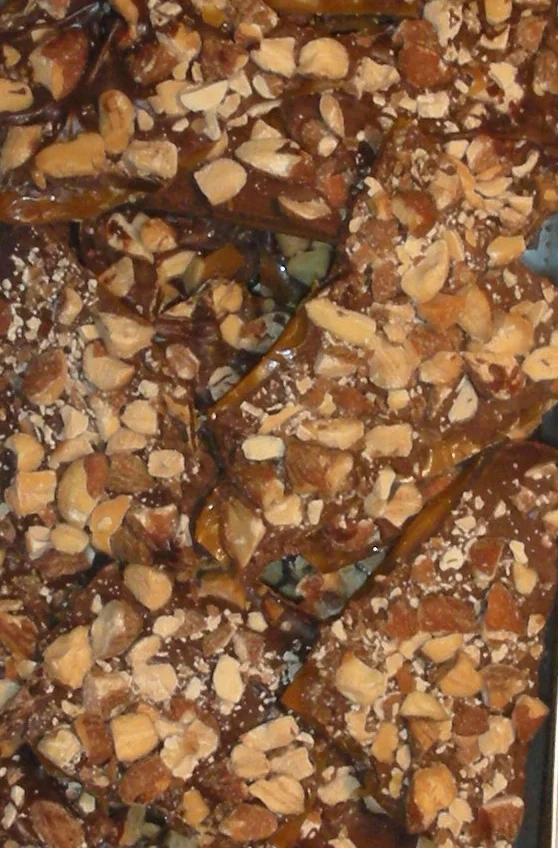
Which was better, Loft’s Butter Crunch or Loft’s Parleys?

For you young ones, those are the two iconic candies once sold by Loft’s, a candy company that went out of business in 1990. I’ve been in mourning ever since.

Their Butter Crunch was always my favorite. My brother insisted that the better choice was the Parley, a giant milk chocolate cigar looking thing with soft nougaty stuff inside.

Parleys were okay but Loft’s Butter Crunch was incomparable. The toffee was thick and brittle. It snapped when you broke it. The chocolate layer wasn’t overly thick so it didn’t detract from the candy part. And the nuts on the outside were tiny and soft, a sensational contrast to the velvety-tender chocolate and the crunchy center.

As well balanced as a dinner straight out of the government’s food pyramid.

I have tried for years to find a Butter Crunch as good as Loft’s, to no avail. There are fancier ones, made with single-estate chocolate or 70% cocoa chocolate. Some really expensive stuff and others from mass producers. Nothing comes close. I will grant you that Loft’s probably didn’t use great chocolate. It wasn’t your most upscale store. It sold modestly priced candies.

It’s just that their Butter Crunch was the best I ever ate.

When I was pregnant with my older daughter I refrained from sweets, to keep my weight at a decent level. But right after she was born I polished off the 2 boxes of Loft’s Butter Crunch that someone brought to me as a gift.

I’ve been experimenting making my own version lately. I made the ones in the photo yesterday to bring as a dinner gift this evening. These are good, so I’m posting the recipe. If you make them with milk chocolate and in a smaller cake pan (8”x8”) they’ll taste like Loft’s. Otherwise use dark chocolate of your choosing and use the larger pan — most people like the crunch part thinner than I do.


Butter Crunch

1 cup butter

3/4 cup sugar

1/4 teaspoon salt

2 tablespoons light corn syrup

2 tablespoons water

9 ounces semisweet chocolate, chopped (1-1/2 cups chocolate chips)

3/4 cup chopped lightly toasted almonds

Lightly butter a 9”x13” sheet cake pan. Place the butter, sugar, salt, corn syrup and water into a deep saucepan. Cook over medium heat, stirring constantly with a wooden spoon until the mixture starts to bubble. Continue to cook, stirring occasionally, until the mixture is golden brown (about 7-8 minutes) or until a candy thermometer reads 280 degrees. Pour the mixture into the prepared pan and spread it out evenly. Immediately sprinkle the chocolate on top. Let it melt briefly, then use a spatula or the back of a large spoon to spread the chocolate evenly over the candy. Keep spreading until the chocolate is completely melted and smooth. Sprinkle the nuts on top and press them in lightly. Let cool until the chocolate is firm and set, about 2 hours. Break into pieces. Makes about 1-1/4 pounds

What Are You Reading?

fridayreads:

Yep, it’s that time again. Reblog this post and add a line about what you’re reading this week. You’ll be joining more than 5,000 readers who share their selections every week, AND you’ll be entered to win great prizes.

I’m reading the 1942 edition of The Good Housekeeping Cook Book, specifically the “Wartime Supplement” for some research I’m doing on old recipes. Really interesting historical perspective on food. #fridayreads